

vibely.sh/settings. Every section has its own address (for example vibely.sh/settings/people), so you can send a teammate straight to the one you mean.
Some sections carry a plan badge (Pro, Business, or Enterprise). A gated section stays visible so you can see what it does; its controls unlock when the workspace is on that plan. The check is enforced on the server, not just in the page.
General workspace settings
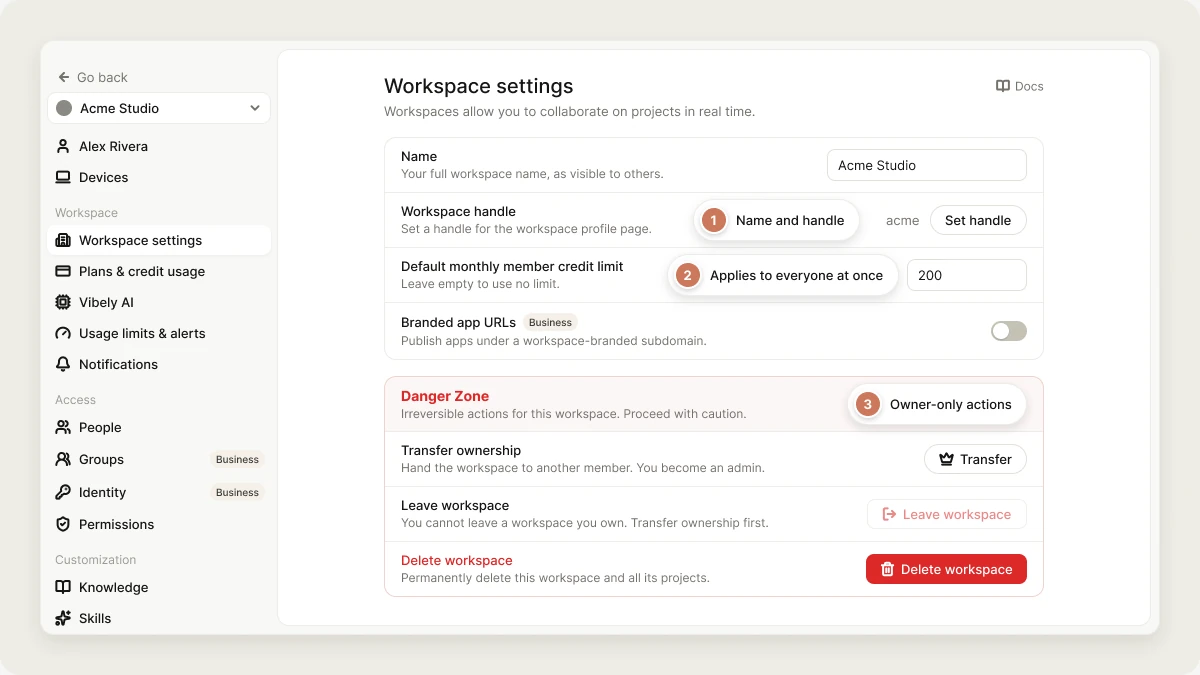
Settings → Workspace settings holds the workspace’s identity and the actions that affect the whole workspace.Billing and usage
These sections answer “what is this workspace spending?”Access
People
Invite members, change roles, remove people, approve join and access requests, set per-member credit limits, and export the member list. See People.Groups (Business)
Named sets of members you can grant project access to, and use to restrict who can open a published app. See Groups.Permissions
A matrix of what each role may do: create web or mobile projects, publish, submit to the app stores, manage connectors and domains, manage billing, invite members, set credit limits, and read audit logs. The owner always has every permission.Identity (Business)
Verify your email domain, set up single sign-on (SAML 2.0 or OIDC), and provision users automatically. See Identity, SSO, and SCIM.Customization
Knowledge
Standing instructions the agent reads in every project in the workspace, such as coding standards, preferred libraries, and tone. Owners and admins can edit it; everyone else can read it. See Knowledge.Skills
Reusable, on-demand instructions the agent loads only when they’re relevant. Opens the Customize area. See Skills.Templates (Business)
Your workspace’s own starting points, shown alongside Vibely’s templates. See Templates.Design systems (Business)
Turn a web project into a design system and attach it to other projects. See Design systems.Connectors (Business)
Connector credentials the whole workspace shares. Opens the Customize area. See Connectors and Admin controls.Build & deploy
Git
The workspace’s GitHub connection and export defaults. See GitHub.Build secrets (Enterprise)
Encrypted values that exist only while a project installs and builds, such as a private npm token. See Build secrets.Managed registry (Enterprise)
A private npm registry for your workspace. See Managed registry.MCP
External MCP servers the agent can call while it builds. See Custom MCP servers.Connected AI apps
Use Vibely from Claude, ChatGPT, Cursor, and other AI apps through the Vibely MCP server. See Vibely MCP server.Workspace domains
Domains the workspace owns, available to any project when you publish. See Custom domains.Security
Privacy & security
Workspace-wide rules for project access, invitations, two-factor authentication, publishing, sharing, abandoned projects, MCP, and data protection. See Privacy & security.Security center (Business)
Your security posture score, SSO and SCIM status, scheduled scans, invitation restrictions, recent workspace activity, and a link to Workspace Insights. See Security center.Audit logs (Business)
A filterable, exportable record of every membership, project, and security change, with CSV export. See Audit logs.Delete a workspace
The workspace owner can delete a workspace from Settings → Workspace settings. Deleting removes the workspace, every project in it, all member access, and its credits and billing history. Deleting a workspace is different from:- Leaving it. To step away from a team, see Leave a workspace.
- Canceling the plan. To stop paying, see Cancel your subscription.
- Deleting your account. To remove your Vibely account entirely, see Delete your account.
Before you delete
1
Cancel the paid plan
A workspace with an active paid subscription can’t be deleted. Cancel it in Settings → Plans & credit usage first.
2
Export the code you want to keep
Export each project you want to keep to GitHub. See GitHub.
3
Unpublish live sites
Deleting a workspace doesn’t take its published sites offline. Unpublish each one first so its URL and custom domain are released. See Publish your web app.
4
Download invoices
Invoices are deleted with the workspace. Download any you need from Settings → Plans & credit usage.
5
Handle store listings
Mobile apps you shipped live in your own Apple and Google developer accounts. They stay on sale after you delete the workspace, but you can no longer build updates. Remove or keep them in App Store Connect and Play Console. See Ship your mobile app.
What gets deleted
Everything that belongs to the workspace is removed at once:- All projects, and everything attached to them
- Members and pending invitations
- Connector connections held by the workspace
- The subscription record, credit balance, and rollover
- The credit ledger and invoices
- Audit logs, including the record of the deletion itself
How to delete a workspace
- Open Settings → Workspace settings.
- Under Danger zone, click Delete workspace.
- Type the workspace name exactly as shown.
- Click Delete workspace.
Related
Vibely workspace
Roles, joining, leaving, and switching workspaces.
Project settings
Settings that apply to one project only.