

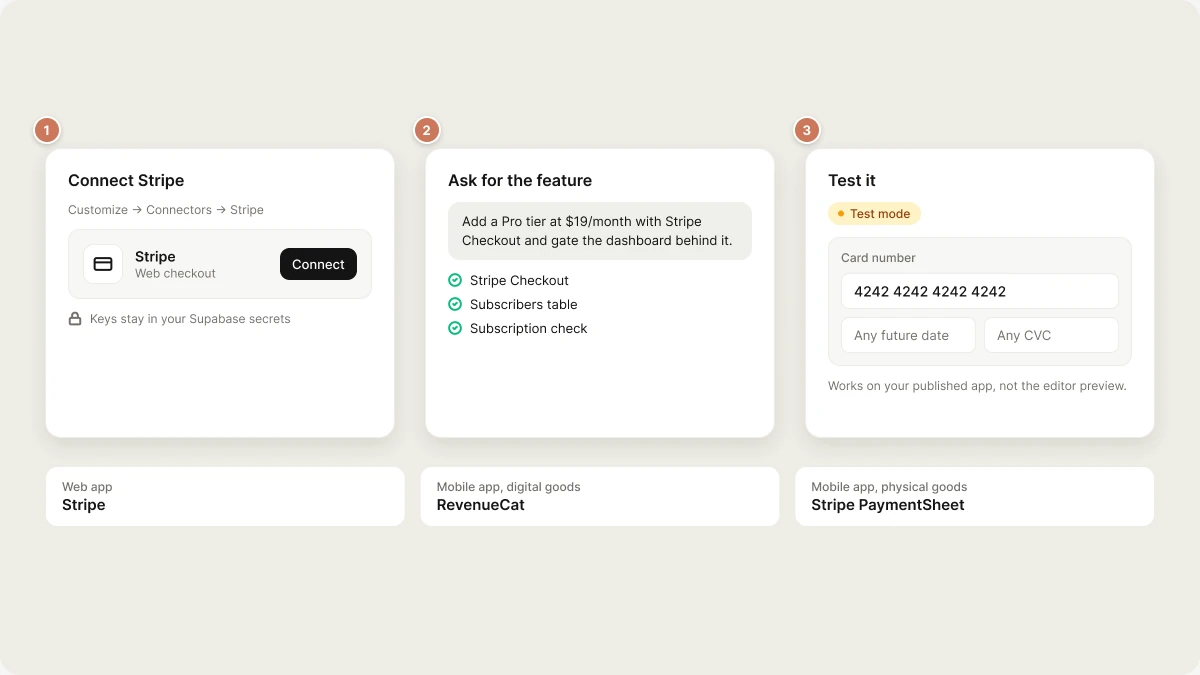
Choose your provider
Which provider you use depends on what you build and what you sell:Before you start
- Stripe (web)
- RevenueCat (mobile)
- A Stripe account, with your products and prices created in the Stripe Dashboard. The generated code uses price IDs (
price_…), not amounts. - Supabase connected to the project. The checkout, subscription check and customer portal run as Supabase Edge Functions, and your secret key is stored there.
- Permission to manage connectors in your workspace. See Admin controls.
Set up payments
- Stripe (web)
- RevenueCat (mobile)
1
Connect Stripe
Open Customize → Connectors → Stripe and click Connect, then sign in to Stripe. Vibely stores your keys in the project’s Supabase Edge Function secrets, so the secret key never reaches the browser.
2
Ask for the feature
For example: “Add a Pro tier at $19/month with Stripe Checkout and gate the dashboard behind it.” Vibely adds the checkout, a subscribers table, and a check that unlocks features for paying users.
3
Add self-serve billing (optional)
“Let subscribers upgrade or cancel themselves.” Vibely wires up Stripe’s customer portal.
Test payments
- Stripe (web)
- RevenueCat (mobile)
- Connect Stripe in test mode while you build.
- Checkout opens Stripe’s hosted page and redirects back to your app, so it only completes on your published app, not in the editor preview. Publish first, then test.
- Use card
4242 4242 4242 4242, any future expiry date and any CVC.
- A successful purchase unlocks the right features.
- A cancelled or failed payment doesn’t.
- Signing out and back in (or switching devices on mobile) keeps access.
- Upgrading, downgrading and cancelling behave as you expect.
Go live
- Stripe: finish activating your account in the Stripe Dashboard, switch to live mode, and reconnect Stripe in Vibely so your live keys replace the test ones. Then publish.
- RevenueCat: submit your in-app products for review with your app build. Once the stores approve them, they appear in your offering. See Ship your app.
Disconnect payments
Open the connector under Customize → Connectors and disconnect it.- Stripe: Vibely revokes its access to your Stripe account, so no new charges go through the app. Customers’ existing subscriptions keep billing in Stripe; cancel them in the Stripe Dashboard if you need to.
- RevenueCat: the SDK keys are removed from the project. Subscriptions are held by Apple and Google; disconnecting doesn’t cancel or refund anything.
FAQ
Does Vibely charge fees on my payments?
Does Vibely charge fees on my payments?
No. Stripe charges its processing fees on your Stripe account, and Apple and Google take their store commission. Vibely takes no cut.
Can I offer monthly and yearly billing, trials, or discounts?
Can I offer monthly and yearly billing, trials, or discounts?
Yes. Create the prices, trials or coupons in Stripe (or the store and RevenueCat for mobile), then ask Vibely to show them in your app.
Why doesn't checkout work in the preview?
Why doesn't checkout work in the preview?
Stripe Checkout redirects back to a real URL, so it only completes on your published app. Publish and test there.
Can I use Stripe for subscriptions in my mobile app?
Can I use Stripe for subscriptions in my mobile app?
No. Apple and Google require in-app purchase for digital goods and subscriptions. Use RevenueCat. Stripe is fine for physical goods and real-world services.
Do I need Supabase?
Do I need Supabase?
For Stripe, yes: the backend code runs as Supabase Edge Functions. RevenueCat doesn’t need Supabase, because RevenueCat holds the purchase state.
Can I use PayPal, Razorpay or another provider?
Can I use PayPal, Razorpay or another provider?
There’s no ready-made connector for them. You can ask Vibely to integrate a provider’s API directly, storing its keys as secrets.
Related
Stripe
Web checkout, subscriptions and the customer portal.
RevenueCat
In-app purchases and subscriptions on iOS and Android.
Supabase
The backend Stripe runs on.
Ship your app
TestFlight, Play testing and store review.