

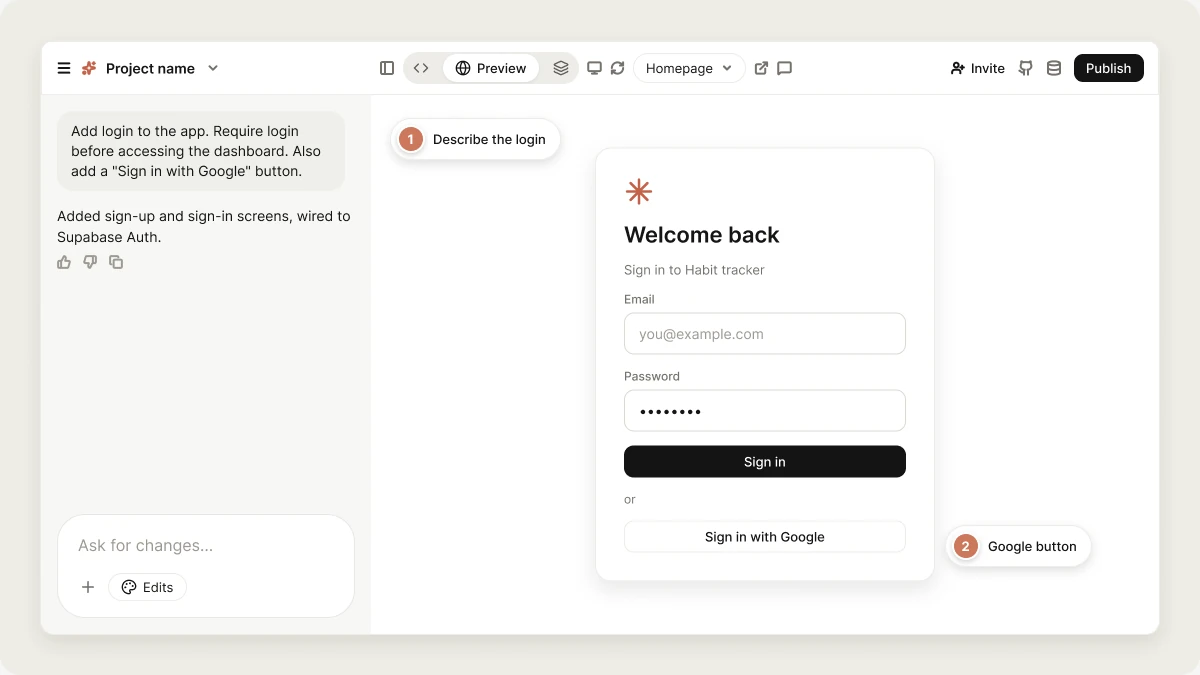
Your app’s users and sign-in settings live in your Supabase project. Vibely has no user list or auth settings screen of its own for your app’s users. You manage them in the Supabase dashboard, or ask the agent in the project chat.
Manage users
Open your project in Supabase (database icon in the editor header → Open Dashboard) and go to Authentication → Users. There you can see everyone who signed up, invite or create users, and delete accounts.Sign-in methods
Supabase supports several sign-in methods. Turn each one on in your Supabase dashboard under Authentication → Providers, then ask the agent to add the matching button or screen to your app. The agent writes the UI and thesupabase.auth calls, but it can’t enable a provider for you, because that step needs your own credentials with the provider.
For social sign-in, the provider’s own console (Google Cloud, Apple Developer, Azure) also needs a redirect URI. Use your Supabase callback,
https://<project-ref>.supabase.co/auth/v1/callback, not your app’s URL. Each Supabase guide above gives the exact value.
Sign-up controls
Who can join your app is controlled in Supabase under Authentication → Sign In / Providers. You can turn off new sign-ups while keeping sign-in for existing users, or allow anonymous sessions for flows such as guest checkout. Ask the agent to build the UI that goes with your choice, for example an invite-only screen.Site URL and redirect URLs
This is where Vibely apps most often break, and it is the one thing Supabase can’t fill in for you. Vibely does not update these settings automatically when you publish or add a domain, so set them yourself. Every redirect-based flow (Google and other social sign-in, magic links, email confirmation, password reset) sends the user away and back. Supabase only completes the round trip if the return URL is on its allowlist. Your app has more than one hostname, and each needs to be there.
Set both in your Supabase dashboard under Authentication → URL Configuration:
1
Set the Site URL
Set it to your published URL,
https://<your-slug>.vibelyagent.com, or your custom domain once it’s verified. Supabase uses this as the fallback when a flow has no explicit redirect, most importantly for the link inside a confirmation email. If it points at the preview, your users get confirmation emails that open a URL only you can load.2
Add every host to Redirect URLs
Add one entry per host your app is served from:Keep all of them. Removing the preview entry breaks sign-in while you build, and removing the published entry breaks it for your users.
3
Check again after any URL change
Changing your slug, adding a custom domain, or moving off
vibelyagent.com all produce a new hostname that Supabase doesn’t know about. Add it before you announce the new URL.Auth emails
Sign-up confirmation, password reset, magic link, and invite emails are sent by Supabase. A new Supabase project sends them through a shared email service with a low hourly limit, meant for testing. Before you launch, set up your own SMTP provider in Supabase under Project Settings → Authentication → SMTP Settings, or confirmation emails stop arriving under real sign-up volume. Email templates are edited in Supabase under Authentication → Email Templates.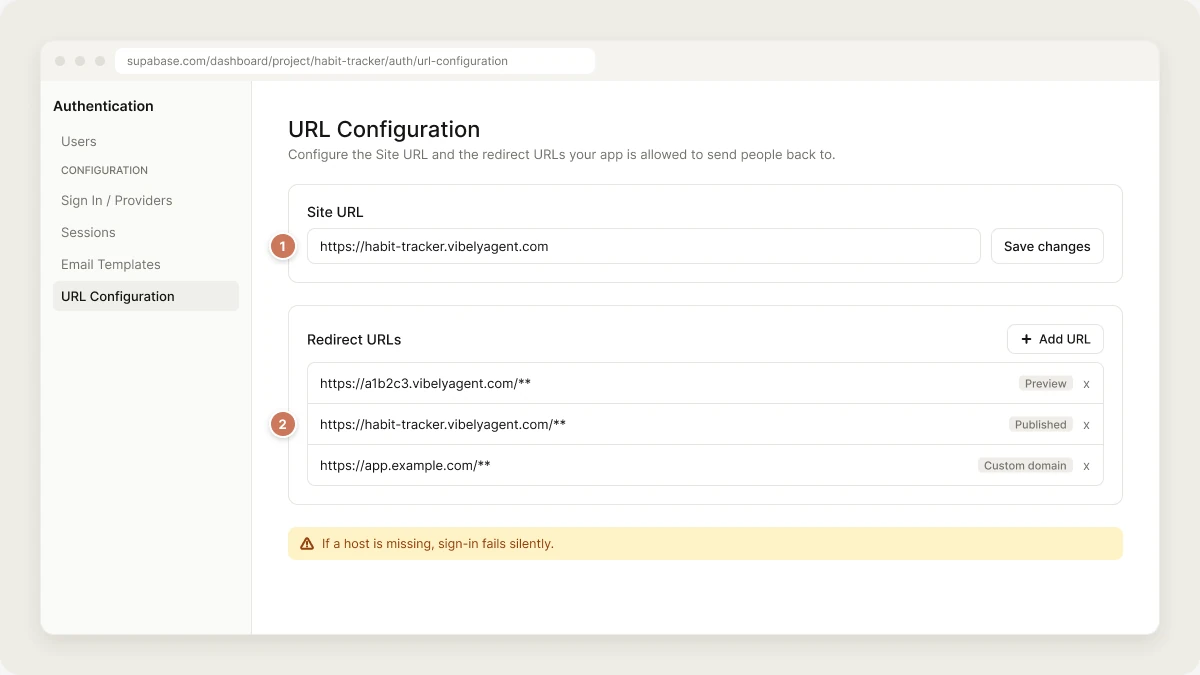
Leaked password protection
When a Supabase project is linked, the project’s Security view shows a Leaked password protection switch. Turn it on to block sign-ups and password changes that use passwords found in known breaches (Have I Been Pwned).Protect data, not just screens
Hiding a page behind a session check is UI, not security. Your Supabase anon key ships in your app’s bundle, so anyone can call your Supabase project directly. Access control lives in row-level security policies on your tables, which the agent writes for every table it creates. See Security best practices, and don’t turn RLS off in production.Test your sign-in flow
Run these on your published URL, in a private window, with an email you haven’t used before:- Sign up. The account appears under Authentication → Users in Supabase.
- Confirm. The emailed link opens your app on the published domain, signed in.
- Sign in. Sign out, then sign back in with each method you enabled.
- Sign out. The session is gone after a hard refresh.
FAQ
Why does sign-in work in the preview but fail on my published app?
Why does sign-in work in the preview but fail on my published app?
Your published URL or custom domain is missing from Redirect URLs in Supabase, or the Site URL still points at the preview. Add the published hostname under Authentication → URL Configuration. If you use Google or another social provider, the provider’s console only needs your Supabase callback URL, which doesn’t change when your app’s domain does.
Can Vibely turn on Google sign-in for me?
Can Vibely turn on Google sign-in for me?
The agent adds the button and the sign-in code. Enabling the provider and entering your Google OAuth client ID and secret happens in your Supabase dashboard, because those are your credentials with Google.
Are my app's users copied when someone remixes the project?
Are my app's users copied when someone remixes the project?
No. A remix copies project files only. Users live in your Supabase project, which isn’t copied.
How do mobile apps sign in?
How do mobile apps sign in?
Native sign-in doesn’t use a web redirect, and the App Store has rules about which providers you offer. See Mobile authentication.
Related
Supabase
Link the Supabase project your app signs users in with.
Mobile authentication
Native sign-in and App Store requirements.
Security best practices
RLS policies that keep each user’s data private.
Publish your app
Get the published URL to add to your redirect list.