

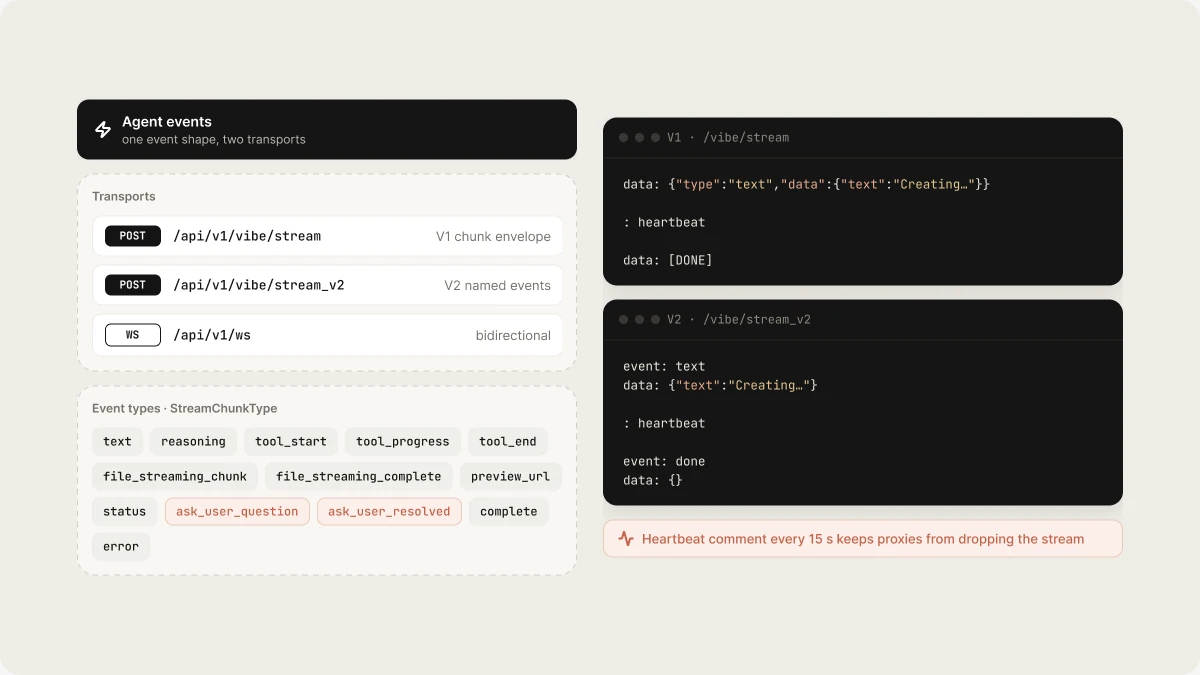
Transports
SSE — Server-Sent Events
Both keep the connection alive with a
: heartbeat\n\n SSE comment every 15 s, which beats the typical 30 s idle timeout on Cloudflare / nginx / ELB. Without it, intermediaries silently drop SSE during long agent turns.
V1 wraps every chunk as data: {"type":…,"data":…} and terminates with data: [DONE]. V2 puts the same type on the SSE event: line and terminates with event: done.
WebSocket
WS /api/v1/ws — bidirectional, 1 MB max payload. The server pushes the same chunk types as SSE. Client-to-server messages are subscribe, unsubscribe, cancel (stops the run), submit_answers (resolves an ask_user_question), console_log_data, and ping.
Event types
Every event carries atype from StreamChunkType in src/types/index.ts — that union is the list. A representative sample:
All events are also fan-out via
EventEmitter to any other subscribers attached to the same project (Redis pub/sub when queue mode is on — see below).
Client close ≠ session abort
Closing the SSE connection does not stop the agent. This is intentional: a flaky network shouldn’t kill a 5-minute build. To explicitly stop a session: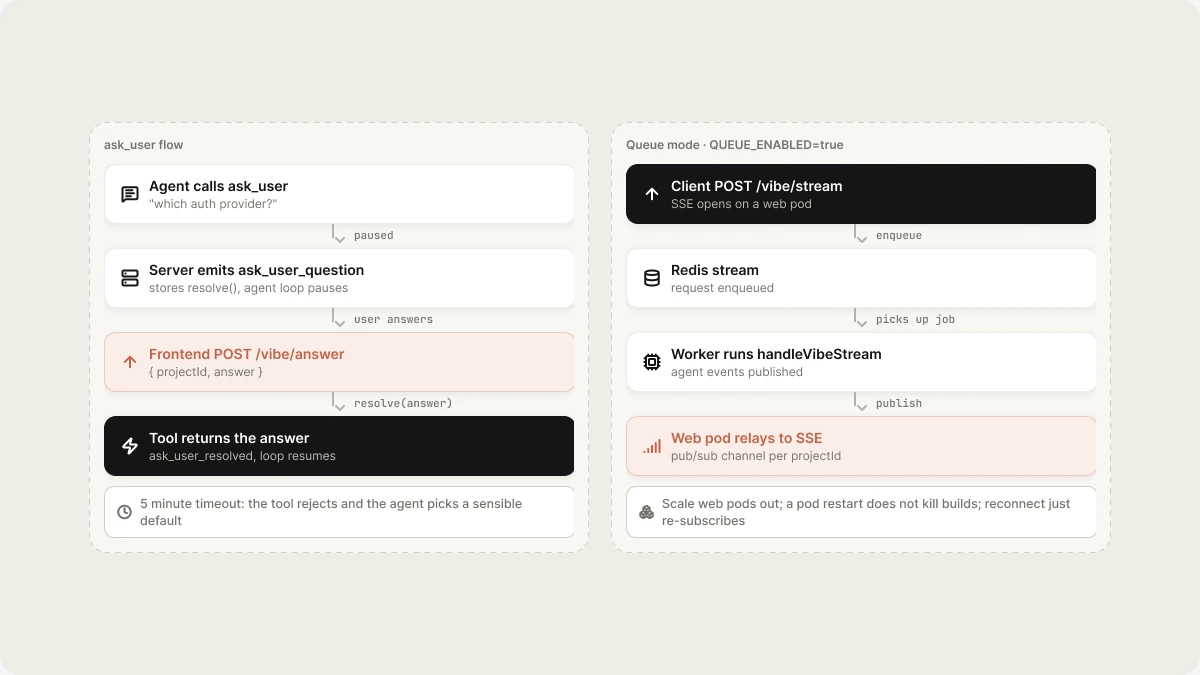
ask_user flow
Queue mode (Redis-backed)
WhenQUEUE_ENABLED=true:
- Horizontal scaling. Many web pods can accept requests; a smaller worker pool processes them. A pod restart doesn’t kill in-flight builds.
- Idempotency. Re-connecting a client to an in-flight session simply re-subscribes to the channel — no duplicate work.
src/queue/ and the relay generator in src/routes/vibe.ts.
Backpressure
Neither SSE writer buffers without limit. Before enqueuing a chunk the stream waits whilecontroller.desiredSize <= 0, backing off 2 ms → 50 ms until the consumer drains. A slow client (a paused tab, a stalled proxy) therefore slows the generator rather than growing a queue until the process OOMs, and browsers absorb short stalls in their own buffer without the user noticing.