> ## Documentation Index
> Fetch the complete documentation index at: https://docs.vibely.sh/llms.txt
> Use this file to discover all available pages before exploring further.
# Glossary
> Definitions of the Vibely terms and general development concepts used throughout the docs.
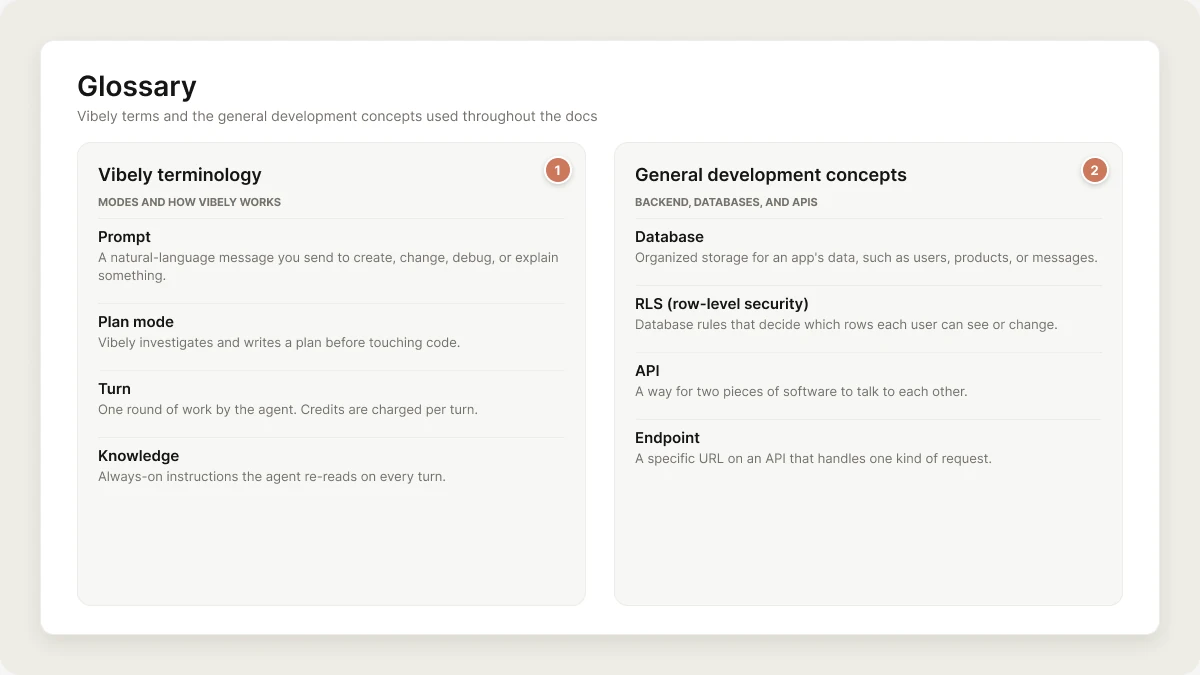
This glossary has two parts:
* **Vibely terminology** covers terms specific to Vibely, its features, and how it works.
* **General development concepts** covers web, mobile, and backend terms that aren't Vibely-specific but come up often in the docs.
 ## Vibely terminology
### Modes and how Vibely works
* **Prompt**: A natural-language message you send to Vibely to create, change, debug, or explain something in your app.
* **[Build mode](/features/agent/build-mode)**: The default mode. Vibely makes the changes you ask for directly. If your message is a pure question, Vibely answers it without changing code.
* **[Plan mode](/features/agent/plan-mode)**: Vibely investigates and writes a plan before touching code. You approve the plan to build it, or ask for changes. Turned on with the **Plan mode** toggle next to the send button.
* **Follow-up**: A message you send while Vibely is still working. It is queued and runs when the current turn finishes.
* **Turn**: One round of work by the agent in response to a message. Credits are charged per turn.
* **Try to fix**: The button on an error card in the chat. It runs a repair turn that doesn't cost credits.
* **[Subagents](/features/agent/subagents)**: Read-only research agents the main agent hands bounded investigations to, so it can keep working.
* **[Knowledge](/features/context/knowledge)**: Always-on instructions the agent re-reads on every turn. Set at the workspace level or per project.
* **[Skills](/features/context/skills)**: Reusable workspace playbooks the agent loads on demand or when one of their triggers matches.
* **[Cross-project referencing](/features/context/cross-project-referencing)**: Pointing the agent at another project in your workspace so it can reuse its code or approach.
### Workspace, projects, and people
* **Account**: Your personal identity on Vibely. One account can belong to many workspaces.
* **[Workspace](/features/workspace/overview)**: Where a team builds together. It holds projects, members, billing, settings, and a shared pool of credits.
* **[Project](/features/projects/overview)**: One app, with its own code, chat, preview, version history, and settings. Every project belongs to one workspace.
* **Web project**: A project that builds a React web app you publish to a URL.
* **Mobile project**: A project that builds a native iOS and Android app with Expo. Requires a Pro plan or higher.
* **Roles**: Owner, Admin, Editor, and Viewer. Each role sets what a member can do in the workspace. See [Collaboration](/features/collaboration/overview).
* **External collaborator**: Someone outside the workspace who has been invited to a specific project.
* **Restricted project**: A project only its owner and invited people can open, even inside the workspace. Business plan.
* **[Groups](/features/workspace/groups)**: Named sets of workspace members, used to control who can open a published app. Business plan.
### Building and editing
* **[Editor](/features/projects/editor)**: The screen where you work on a project, with the project chat on one side and the preview or code on the other.
* **[Project chat](/features/projects/chat)**: Where you talk to Vibely about a project.
* **Composer**: The message box in the project chat, with the **+** menu for attachments, skills, connectors, and web search.
* **[Preview](/features/projects/preview)**: The live, interactive version of your app inside the editor. It updates as Vibely builds.
* **[Code editor](/features/projects/code-editor)**: The **Code** tab, where you browse and edit the project's files.
* **[Visual edits](/features/design/visual-edits)**: Changing an element by clicking it in the preview, turned on with **Edits** in the composer.
* **[Comments](/features/collaboration/comments)**: Feedback pinned to a spot in the preview, discussed in a thread, and sent to Vibely to fix.
* **[Version history](/features/projects/history)**: The saved versions of your project. You can restore any of them.
* **[Remix](/features/projects/remix)**: Making an independent copy of a project that you can change freely.
* **[Template](/features/design/workspace-templates)**: A working app you start a new project from.
* **[Design system](/features/design/design-systems)**: A reusable palette, type scale, component set, and rules shared across projects.
* **[Sandbox](/reference/engine/sandbox)**: The isolated cloud machine where each project's code builds and runs.
### Publishing and hosting
* **[Publish](/features/deploy/publish)**: Deploying your app to a live URL. The live site is a snapshot: later changes go live only when you publish again.
* **Unpublished changes**: Changes in the preview that aren't on the live site yet. Select **Update** in the publish panel to push them live.
* **Website access**: Who can see a published app, set under **Who can see this website** when you publish.
* **`vibelyagent.com` address**: The free address every published web app gets, on every plan. See [Hosting](/features/deploy/hosting).
* **[Custom domain](/features/deploy/custom-domain)**: A domain you own, pointed at your published app. Pro plan or higher.
* **[Branded workspace URLs](/features/deploy/branded-urls)**: A workspace-wide address pattern for every published app. Business plan.
### Mobile
* **Expo Go**: The phone app you use to open a mobile project's live preview on a real device.
* **EAS build**: A native iOS (`.ipa`) or Android (`.aab`) build of a mobile project, made on Expo Application Services.
* **[Store submission](/features/mobile-apps/ship)**: Sending a finished build to TestFlight or Google Play from the editor.
### Backend and secrets
* **[Supabase](/integrations/supabase)**: The backend Vibely connects your projects to, in your own Supabase account: a Postgres database, authentication, storage, and edge functions.
* **[Secrets](/features/backend/secrets)**: Encrypted values such as API keys, stored per project and available to the running app. Never returned in plain text.
* **[Build secrets](/features/build/build-secrets)**: Encrypted workspace values available only while a project installs and builds, such as an npm token. Enterprise plan.
* **[Managed registry](/features/build/managed-registry)**: A private npm registry inside your workspace. Enterprise plan.
### Security
* **[Security view](/features/security/project-view)**: A project's scan results, where you fix findings from chat.
* **[Security center](/features/workspace/security-center)**: The workspace-wide view of security posture, identity status, audit activity, and scheduled scans. Business plan.
* **[Workspace insights](/features/workspace/insights)**: A ranking of workspace projects by how urgently they need a security review. Business plan.
* **Publish gate**: A workspace setting that blocks publishing when a scan reports critical issues.
### Integrations
* **[Connector](/integrations/connectors/overview)**: A connection to an outside service, such as Stripe, GitHub, Notion, or Linear, that your app or the agent can use.
* **[Custom MCP server](/integrations/connectors/custom-mcp)**: Your own MCP server, added so the agent can call its tools while it builds.
* **[Vibely MCP server](/integrations/vibely-mcp-server)**: The server that lets AI assistants such as Claude, ChatGPT, and Cursor work in your Vibely account.
* **[Vibely AI](/features/backend/ai)**: Built-in AI for the apps you build, such as chat, summaries, images, and speech, without you holding a provider API key.
* **[Git sync](/integrations/git-sync)**: Keeping a project in step with a GitHub repository.
### Plans, credits, and billing
* **[Credits](/features/account/credits)**: Vibely's unit of AI spend. Agent turns use credits; publishing, hosting, and preview time don't.
* **Daily credits**: Free credits every plan gets each day. They refill at 00:00 UTC, don't carry over, and are spent first.
* **Monthly grant**: The credits your plan adds to the workspace each billing cycle.
* **Rollover**: Unused monthly credits carried into the next cycle on paid plans, spent after daily credits and before the new grant.
* **Top-up**: Extra credits bought separately from your subscription, once or with auto top-up. They're spent last, aren't reset when your plan renews, and expire 12 months after your workspace's most recent top-up.
* **Usage limits and alerts**: Workspace settings that cap spending and warn you before credits run out.
* **[Plans](/features/account/plans)**: Free, Pro, and Business are self-serve. [Enterprise](/introduction/enterprise) is set on a signed Order.
## General development concepts
### Frontend and UI
* **Frontend**: The part of an app people see and interact with.
* **React**: The JavaScript library Vibely web projects use to build interfaces.
* **React Native**: The framework Vibely mobile projects use to build native iOS and Android interfaces from React code.
* **Expo**: The toolkit around React Native that Vibely mobile projects are built on.
* **Tailwind CSS**: The utility-first CSS framework used to style Vibely web projects.
* **Component**: A reusable piece of UI, such as a button, card, or form, combined to build screens.
* **Responsive design**: Layouts that adapt to phones, tablets, and desktops.
* **Hero section**: The prominent area at the top of a landing page, usually with a headline, subheading, and call to action.
* **CTA (call to action)**: A button or link asking the user to do something, such as "Sign up" or "Get started".
* **Modal or dialog**: An overlay window that asks for attention or input.
* **Toast**: A brief notification that appears and disappears on its own.
* **Favicon**: The small icon shown in browser tabs and bookmarks.
### Backend, databases, and APIs
* **Backend**: The behind-the-scenes part of an app, where data is stored, rules are enforced, and users are signed in.
* **Database**: Organized storage for an app's data, such as users, products, or messages.
* **PostgreSQL**: The open-source database behind Supabase, where your app's data lives.
* **SQL**: The language used to read and change data in a relational database.
* **RLS (row-level security)**: Database rules that decide which rows each user can see or change, such as "users can only read their own orders".
* **API**: A way for two pieces of software to talk to each other.
* **Endpoint**: A specific URL on an API that handles one kind of request.
* **Webhook**: A message another service sends to your app when something happens, such as Stripe reporting a successful payment.
* **Edge function**: Server-side code that runs on demand close to your users, used for work the browser shouldn't do, such as calling an API with a secret key.
* **Environment variable**: A named value, such as an API key, that the app reads at build or run time instead of hard-coding it.
### Authentication and security
* **OAuth**: A standard that lets users sign in with an existing account, such as Google, without sharing their password.
* **SSO (single sign-on)**: Signing in to many tools through one company identity provider.
* **SAML and OIDC**: The two standards identity providers use for SSO.
* **SCIM**: A standard that lets an identity provider create and remove user accounts automatically.
* **2FA (two-factor authentication)**: A second verification step on top of a password.
* **MCP (Model Context Protocol)**: An open standard that lets AI assistants discover and call external tools.
### SEO and discoverability
* **SEO (search engine optimization)**: Making a site easy for search engines to find, understand, and rank.
* **Meta title and description**: The page title and summary shown in search results.
* **Sitemap**: A file listing a site's pages so search engines can crawl them.
* **robots.txt**: A file telling crawlers which paths they may visit.
* **Open Graph**: Tags that control how a page looks when shared on social platforms.
## Related topics
- [Welcome to Vibely](/introduction/welcome.md)
This documentation is built and hosted on [Mintlify](https://mintlify.com), a developer documentation platform.
## Vibely terminology
### Modes and how Vibely works
* **Prompt**: A natural-language message you send to Vibely to create, change, debug, or explain something in your app.
* **[Build mode](/features/agent/build-mode)**: The default mode. Vibely makes the changes you ask for directly. If your message is a pure question, Vibely answers it without changing code.
* **[Plan mode](/features/agent/plan-mode)**: Vibely investigates and writes a plan before touching code. You approve the plan to build it, or ask for changes. Turned on with the **Plan mode** toggle next to the send button.
* **Follow-up**: A message you send while Vibely is still working. It is queued and runs when the current turn finishes.
* **Turn**: One round of work by the agent in response to a message. Credits are charged per turn.
* **Try to fix**: The button on an error card in the chat. It runs a repair turn that doesn't cost credits.
* **[Subagents](/features/agent/subagents)**: Read-only research agents the main agent hands bounded investigations to, so it can keep working.
* **[Knowledge](/features/context/knowledge)**: Always-on instructions the agent re-reads on every turn. Set at the workspace level or per project.
* **[Skills](/features/context/skills)**: Reusable workspace playbooks the agent loads on demand or when one of their triggers matches.
* **[Cross-project referencing](/features/context/cross-project-referencing)**: Pointing the agent at another project in your workspace so it can reuse its code or approach.
### Workspace, projects, and people
* **Account**: Your personal identity on Vibely. One account can belong to many workspaces.
* **[Workspace](/features/workspace/overview)**: Where a team builds together. It holds projects, members, billing, settings, and a shared pool of credits.
* **[Project](/features/projects/overview)**: One app, with its own code, chat, preview, version history, and settings. Every project belongs to one workspace.
* **Web project**: A project that builds a React web app you publish to a URL.
* **Mobile project**: A project that builds a native iOS and Android app with Expo. Requires a Pro plan or higher.
* **Roles**: Owner, Admin, Editor, and Viewer. Each role sets what a member can do in the workspace. See [Collaboration](/features/collaboration/overview).
* **External collaborator**: Someone outside the workspace who has been invited to a specific project.
* **Restricted project**: A project only its owner and invited people can open, even inside the workspace. Business plan.
* **[Groups](/features/workspace/groups)**: Named sets of workspace members, used to control who can open a published app. Business plan.
### Building and editing
* **[Editor](/features/projects/editor)**: The screen where you work on a project, with the project chat on one side and the preview or code on the other.
* **[Project chat](/features/projects/chat)**: Where you talk to Vibely about a project.
* **Composer**: The message box in the project chat, with the **+** menu for attachments, skills, connectors, and web search.
* **[Preview](/features/projects/preview)**: The live, interactive version of your app inside the editor. It updates as Vibely builds.
* **[Code editor](/features/projects/code-editor)**: The **Code** tab, where you browse and edit the project's files.
* **[Visual edits](/features/design/visual-edits)**: Changing an element by clicking it in the preview, turned on with **Edits** in the composer.
* **[Comments](/features/collaboration/comments)**: Feedback pinned to a spot in the preview, discussed in a thread, and sent to Vibely to fix.
* **[Version history](/features/projects/history)**: The saved versions of your project. You can restore any of them.
* **[Remix](/features/projects/remix)**: Making an independent copy of a project that you can change freely.
* **[Template](/features/design/workspace-templates)**: A working app you start a new project from.
* **[Design system](/features/design/design-systems)**: A reusable palette, type scale, component set, and rules shared across projects.
* **[Sandbox](/reference/engine/sandbox)**: The isolated cloud machine where each project's code builds and runs.
### Publishing and hosting
* **[Publish](/features/deploy/publish)**: Deploying your app to a live URL. The live site is a snapshot: later changes go live only when you publish again.
* **Unpublished changes**: Changes in the preview that aren't on the live site yet. Select **Update** in the publish panel to push them live.
* **Website access**: Who can see a published app, set under **Who can see this website** when you publish.
* **`vibelyagent.com` address**: The free address every published web app gets, on every plan. See [Hosting](/features/deploy/hosting).
* **[Custom domain](/features/deploy/custom-domain)**: A domain you own, pointed at your published app. Pro plan or higher.
* **[Branded workspace URLs](/features/deploy/branded-urls)**: A workspace-wide address pattern for every published app. Business plan.
### Mobile
* **Expo Go**: The phone app you use to open a mobile project's live preview on a real device.
* **EAS build**: A native iOS (`.ipa`) or Android (`.aab`) build of a mobile project, made on Expo Application Services.
* **[Store submission](/features/mobile-apps/ship)**: Sending a finished build to TestFlight or Google Play from the editor.
### Backend and secrets
* **[Supabase](/integrations/supabase)**: The backend Vibely connects your projects to, in your own Supabase account: a Postgres database, authentication, storage, and edge functions.
* **[Secrets](/features/backend/secrets)**: Encrypted values such as API keys, stored per project and available to the running app. Never returned in plain text.
* **[Build secrets](/features/build/build-secrets)**: Encrypted workspace values available only while a project installs and builds, such as an npm token. Enterprise plan.
* **[Managed registry](/features/build/managed-registry)**: A private npm registry inside your workspace. Enterprise plan.
### Security
* **[Security view](/features/security/project-view)**: A project's scan results, where you fix findings from chat.
* **[Security center](/features/workspace/security-center)**: The workspace-wide view of security posture, identity status, audit activity, and scheduled scans. Business plan.
* **[Workspace insights](/features/workspace/insights)**: A ranking of workspace projects by how urgently they need a security review. Business plan.
* **Publish gate**: A workspace setting that blocks publishing when a scan reports critical issues.
### Integrations
* **[Connector](/integrations/connectors/overview)**: A connection to an outside service, such as Stripe, GitHub, Notion, or Linear, that your app or the agent can use.
* **[Custom MCP server](/integrations/connectors/custom-mcp)**: Your own MCP server, added so the agent can call its tools while it builds.
* **[Vibely MCP server](/integrations/vibely-mcp-server)**: The server that lets AI assistants such as Claude, ChatGPT, and Cursor work in your Vibely account.
* **[Vibely AI](/features/backend/ai)**: Built-in AI for the apps you build, such as chat, summaries, images, and speech, without you holding a provider API key.
* **[Git sync](/integrations/git-sync)**: Keeping a project in step with a GitHub repository.
### Plans, credits, and billing
* **[Credits](/features/account/credits)**: Vibely's unit of AI spend. Agent turns use credits; publishing, hosting, and preview time don't.
* **Daily credits**: Free credits every plan gets each day. They refill at 00:00 UTC, don't carry over, and are spent first.
* **Monthly grant**: The credits your plan adds to the workspace each billing cycle.
* **Rollover**: Unused monthly credits carried into the next cycle on paid plans, spent after daily credits and before the new grant.
* **Top-up**: Extra credits bought separately from your subscription, once or with auto top-up. They're spent last, aren't reset when your plan renews, and expire 12 months after your workspace's most recent top-up.
* **Usage limits and alerts**: Workspace settings that cap spending and warn you before credits run out.
* **[Plans](/features/account/plans)**: Free, Pro, and Business are self-serve. [Enterprise](/introduction/enterprise) is set on a signed Order.
## General development concepts
### Frontend and UI
* **Frontend**: The part of an app people see and interact with.
* **React**: The JavaScript library Vibely web projects use to build interfaces.
* **React Native**: The framework Vibely mobile projects use to build native iOS and Android interfaces from React code.
* **Expo**: The toolkit around React Native that Vibely mobile projects are built on.
* **Tailwind CSS**: The utility-first CSS framework used to style Vibely web projects.
* **Component**: A reusable piece of UI, such as a button, card, or form, combined to build screens.
* **Responsive design**: Layouts that adapt to phones, tablets, and desktops.
* **Hero section**: The prominent area at the top of a landing page, usually with a headline, subheading, and call to action.
* **CTA (call to action)**: A button or link asking the user to do something, such as "Sign up" or "Get started".
* **Modal or dialog**: An overlay window that asks for attention or input.
* **Toast**: A brief notification that appears and disappears on its own.
* **Favicon**: The small icon shown in browser tabs and bookmarks.
### Backend, databases, and APIs
* **Backend**: The behind-the-scenes part of an app, where data is stored, rules are enforced, and users are signed in.
* **Database**: Organized storage for an app's data, such as users, products, or messages.
* **PostgreSQL**: The open-source database behind Supabase, where your app's data lives.
* **SQL**: The language used to read and change data in a relational database.
* **RLS (row-level security)**: Database rules that decide which rows each user can see or change, such as "users can only read their own orders".
* **API**: A way for two pieces of software to talk to each other.
* **Endpoint**: A specific URL on an API that handles one kind of request.
* **Webhook**: A message another service sends to your app when something happens, such as Stripe reporting a successful payment.
* **Edge function**: Server-side code that runs on demand close to your users, used for work the browser shouldn't do, such as calling an API with a secret key.
* **Environment variable**: A named value, such as an API key, that the app reads at build or run time instead of hard-coding it.
### Authentication and security
* **OAuth**: A standard that lets users sign in with an existing account, such as Google, without sharing their password.
* **SSO (single sign-on)**: Signing in to many tools through one company identity provider.
* **SAML and OIDC**: The two standards identity providers use for SSO.
* **SCIM**: A standard that lets an identity provider create and remove user accounts automatically.
* **2FA (two-factor authentication)**: A second verification step on top of a password.
* **MCP (Model Context Protocol)**: An open standard that lets AI assistants discover and call external tools.
### SEO and discoverability
* **SEO (search engine optimization)**: Making a site easy for search engines to find, understand, and rank.
* **Meta title and description**: The page title and summary shown in search results.
* **Sitemap**: A file listing a site's pages so search engines can crawl them.
* **robots.txt**: A file telling crawlers which paths they may visit.
* **Open Graph**: Tags that control how a page looks when shared on social platforms.
## Related topics
- [Welcome to Vibely](/introduction/welcome.md)
This documentation is built and hosted on [Mintlify](https://mintlify.com), a developer documentation platform.