> ## Documentation Index
> Fetch the complete documentation index at: https://docs.vibely.sh/llms.txt
> Use this file to discover all available pages before exploring further.
# Test and verify your app
> What Vibely checks automatically after every change and every publish, and the browser testing you can ask for when a flow needs a click-through.
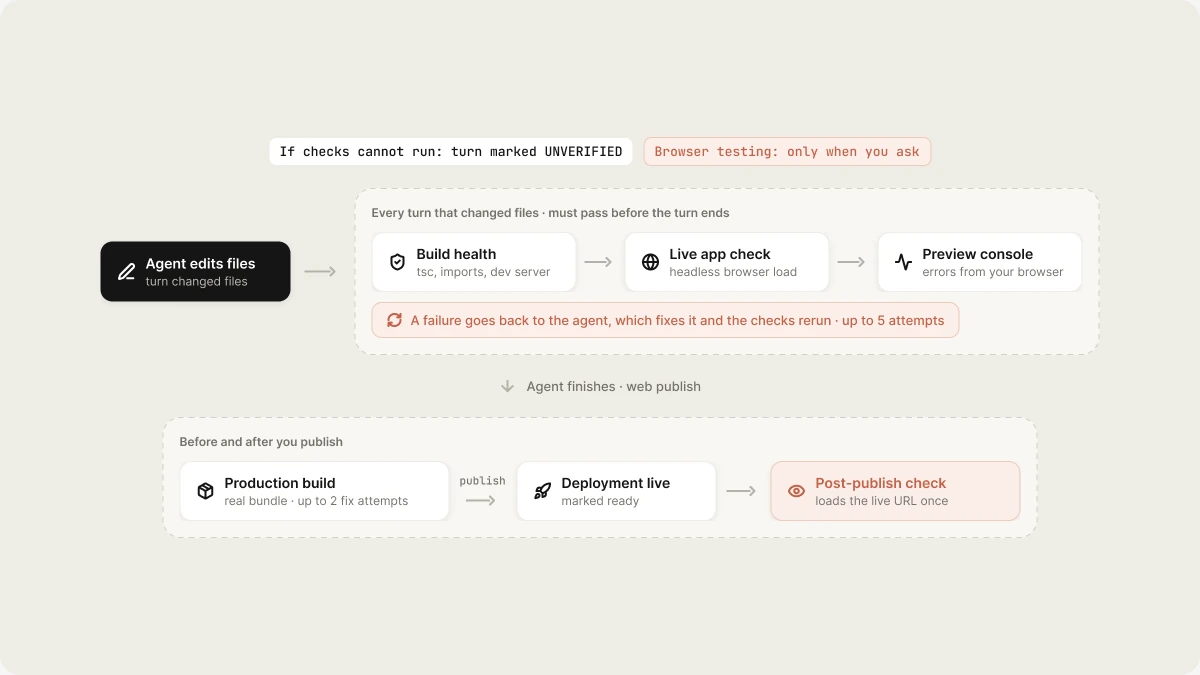
Vibely checks your app as it builds it. Every turn that changes files is type-checked and, when the change could affect what renders, loaded in a real browser before the agent is allowed to finish. Every web publish is preceded by a real production build and followed by one load of the live URL. On top of that, you can ask the agent to test a specific flow in a browser.
 **Choose the right check**
* Something looks broken in the preview: ask the agent to fix it. It reads the errors your preview already captured first.
* A bug needs clicking through to reproduce, such as sign-in or checkout: ask for a browser test of that flow.
* A rule should stay true over time: ask the agent to write tests for it.
## What Vibely observes
While verifying, Vibely can see:
* Type errors, broken imports, and packages used without being installed.
* The error overlay, uncaught errors, and render crashes when the app loads.
* Console errors captured from the preview open in your browser.
* Failed requests for your own assets, and Supabase API calls that return errors.
* A page that renders almost nothing, with no error to explain why.
These signals go straight back to the agent, so most problems are fixed before you see them.
## Automatic checks
These run without you asking and don't use extra credits beyond the turn itself.
| Check | When | Blocks the turn? | What it catches |
| - | - | - | - |
| Build health | Every turn that changed files | Yes | Type errors, imports of packages that aren't installed, a broken route tree, a dev server that stopped responding |
| Live app check | Same turn, when the change could render | Yes | What only a page load shows: the error overlay, uncaught errors, hydration mismatches, a blank page |
| Preview console | Same turn | Yes | Errors captured from a real browser showing your preview |
| Production build | Web projects, after the agent finishes | Yes, with up to 2 fix attempts | Problems that exist only in a bundled build |
| Metro bundle check | Mobile projects, after the agent finishes | Yes | The bundle Expo Go will actually load |
| Post-publish check | After a web deployment goes live | No | Problems a first visitor would hit on the live URL |
| Basic security scan | Every publish, in the background | No | See [Security view](/features/security/project-view) |
### The check after every change
When the agent has written or edited files, it can't end the turn until the checks pass.
Route types are regenerated, the TypeScript compiler runs, the code is scanned for imports of packages that aren't in `package.json`, and the dev server is asked whether it's still responding.
A headless browser in the cloud sandbox opens the routes this turn changed and reports what happened. When several routes need checking, they load in one browser session.
Errors captured from the preview in your browser since this turn's changes are read back.
A failure isn't a dead end. The error goes back to the agent, which fixes it, and the checks run again, up to 5 attempts per turn.
The live app check is skipped when a turn changed nothing that renders, such as a config file or a script, because the preview and console already cover it.
If the checks can't run at all, for example because the sandbox stopped responding, the turn is accepted and marked **UNVERIFIED** rather than reported as clean.
### The production build
A dev server isn't a bundler, so some problems only appear in a real build. Web projects get a full production build after the agent finishes, with up to 2 fix attempts if it fails. Mobile projects get the equivalent: a real Metro bundle.
### After you publish
Some faults exist only in the deployed app. After a web deployment is marked ready, Vibely loads the live URL once and records what a first visitor would have hit. This never blocks the publish: your app stays live, and any findings are recorded as errors you can see and act on. See [Monitoring](/features/grow/monitoring).
## Browser testing
Browser testing checks real user behavior by driving your app's preview in a browser. The agent can open a route, click buttons, fill forms, confirm that specific text actually rendered, read page errors and the network log, and reopen the page at a mobile width.
Use browser testing when:
* a bug needs a click-through to reproduce
* you want a multi-step flow such as onboarding, sign-in, or checkout confirmed end to end
* the issue may depend on routing, authentication, or timing
Browser testing runs only when you ask for it or report a bug. It doesn't run on routine builds, because each run takes time and credits.
**Example**
```text wrap theme={"system"}
Test the checkout flow in the browser and fix anything that breaks.
```
When something looks broken, the agent first reads the errors your preview already captured. That needs no browser and is usually enough. It opens a browser only when the errors don't explain the problem.
## Tests in your code
Vibely doesn't add a test runner to new projects. If you want automated tests, such as unit tests for a form or a pricing rule, ask for them and the agent writes them and sets up what they need.
```text wrap theme={"system"}
Write tests for the login form's validation rules and run them.
```
Tests you add this way aren't part of Vibely's automatic checks. They run when you or the agent run them.
## Mobile apps
Verification for an Expo project is narrower than on the web, and it matters before you submit to a store.
| What's checked | What that proves |
| - | - |
| Build health passes | Types and routes are consistent, and every import is a declared dependency |
| The Metro bundle builds | The bundle Expo Go loads actually resolves |
| Metro's log is scanned for fatal startup errors | The bundler didn't fail on a bad config |
What isn't checked:
* **Native features in the preview.** The in-editor preview is a web build. It doesn't exercise the camera, push notifications, biometrics, secure storage, or in-app purchases. See [Native features](/features/mobile-apps/native).
* **Real devices.** Nothing taps through your app on a phone before you do. Use Expo Go, TestFlight, or Play internal testing.
* **Store readiness.** A successful native build means the binary compiled, not that it works or will pass review.
See [Ship to stores](/features/mobile-apps/ship).
## FAQ
No. Every change is already type-checked and loaded in a browser automatically. Ask for a browser test when you want a specific flow clicked through, and for written tests when you want a rule locked down.
Ask the agent to test the flow in the browser, so it can see the problem the way a user does. Describe the exact steps and what you expected. If it still isn't resolved, restore a version that worked from [version history](/features/projects/history), then try a smaller change. See [Debugging](/prompting/debugging).
The automatic checks run as part of every turn and every publish. Browser testing never runs silently: it happens only when you ask for it or report a bug.
## Related
Try your app as you build it.
How to describe a bug so it gets fixed.
Scan your project for vulnerabilities.
See errors from your live app.
## Related topics
- [Preview and test your app](/features/projects/preview.md)
- [Add payments to your app](/features/grow/payments.md)
- [Optimize your app for SEO and AI search](/features/grow/seo.md)
- [Manage workspace identity and user provisioning](/features/workspace/identity.md)
- [Ship to stores](/features/mobile-apps/ship.md)
This documentation is built and hosted on [Mintlify](https://mintlify.com), a developer documentation platform.
**Choose the right check**
* Something looks broken in the preview: ask the agent to fix it. It reads the errors your preview already captured first.
* A bug needs clicking through to reproduce, such as sign-in or checkout: ask for a browser test of that flow.
* A rule should stay true over time: ask the agent to write tests for it.
## What Vibely observes
While verifying, Vibely can see:
* Type errors, broken imports, and packages used without being installed.
* The error overlay, uncaught errors, and render crashes when the app loads.
* Console errors captured from the preview open in your browser.
* Failed requests for your own assets, and Supabase API calls that return errors.
* A page that renders almost nothing, with no error to explain why.
These signals go straight back to the agent, so most problems are fixed before you see them.
## Automatic checks
These run without you asking and don't use extra credits beyond the turn itself.
| Check | When | Blocks the turn? | What it catches |
| - | - | - | - |
| Build health | Every turn that changed files | Yes | Type errors, imports of packages that aren't installed, a broken route tree, a dev server that stopped responding |
| Live app check | Same turn, when the change could render | Yes | What only a page load shows: the error overlay, uncaught errors, hydration mismatches, a blank page |
| Preview console | Same turn | Yes | Errors captured from a real browser showing your preview |
| Production build | Web projects, after the agent finishes | Yes, with up to 2 fix attempts | Problems that exist only in a bundled build |
| Metro bundle check | Mobile projects, after the agent finishes | Yes | The bundle Expo Go will actually load |
| Post-publish check | After a web deployment goes live | No | Problems a first visitor would hit on the live URL |
| Basic security scan | Every publish, in the background | No | See [Security view](/features/security/project-view) |
### The check after every change
When the agent has written or edited files, it can't end the turn until the checks pass.
Route types are regenerated, the TypeScript compiler runs, the code is scanned for imports of packages that aren't in `package.json`, and the dev server is asked whether it's still responding.
A headless browser in the cloud sandbox opens the routes this turn changed and reports what happened. When several routes need checking, they load in one browser session.
Errors captured from the preview in your browser since this turn's changes are read back.
A failure isn't a dead end. The error goes back to the agent, which fixes it, and the checks run again, up to 5 attempts per turn.
The live app check is skipped when a turn changed nothing that renders, such as a config file or a script, because the preview and console already cover it.
If the checks can't run at all, for example because the sandbox stopped responding, the turn is accepted and marked **UNVERIFIED** rather than reported as clean.
### The production build
A dev server isn't a bundler, so some problems only appear in a real build. Web projects get a full production build after the agent finishes, with up to 2 fix attempts if it fails. Mobile projects get the equivalent: a real Metro bundle.
### After you publish
Some faults exist only in the deployed app. After a web deployment is marked ready, Vibely loads the live URL once and records what a first visitor would have hit. This never blocks the publish: your app stays live, and any findings are recorded as errors you can see and act on. See [Monitoring](/features/grow/monitoring).
## Browser testing
Browser testing checks real user behavior by driving your app's preview in a browser. The agent can open a route, click buttons, fill forms, confirm that specific text actually rendered, read page errors and the network log, and reopen the page at a mobile width.
Use browser testing when:
* a bug needs a click-through to reproduce
* you want a multi-step flow such as onboarding, sign-in, or checkout confirmed end to end
* the issue may depend on routing, authentication, or timing
Browser testing runs only when you ask for it or report a bug. It doesn't run on routine builds, because each run takes time and credits.
**Example**
```text wrap theme={"system"}
Test the checkout flow in the browser and fix anything that breaks.
```
When something looks broken, the agent first reads the errors your preview already captured. That needs no browser and is usually enough. It opens a browser only when the errors don't explain the problem.
## Tests in your code
Vibely doesn't add a test runner to new projects. If you want automated tests, such as unit tests for a form or a pricing rule, ask for them and the agent writes them and sets up what they need.
```text wrap theme={"system"}
Write tests for the login form's validation rules and run them.
```
Tests you add this way aren't part of Vibely's automatic checks. They run when you or the agent run them.
## Mobile apps
Verification for an Expo project is narrower than on the web, and it matters before you submit to a store.
| What's checked | What that proves |
| - | - |
| Build health passes | Types and routes are consistent, and every import is a declared dependency |
| The Metro bundle builds | The bundle Expo Go loads actually resolves |
| Metro's log is scanned for fatal startup errors | The bundler didn't fail on a bad config |
What isn't checked:
* **Native features in the preview.** The in-editor preview is a web build. It doesn't exercise the camera, push notifications, biometrics, secure storage, or in-app purchases. See [Native features](/features/mobile-apps/native).
* **Real devices.** Nothing taps through your app on a phone before you do. Use Expo Go, TestFlight, or Play internal testing.
* **Store readiness.** A successful native build means the binary compiled, not that it works or will pass review.
See [Ship to stores](/features/mobile-apps/ship).
## FAQ
No. Every change is already type-checked and loaded in a browser automatically. Ask for a browser test when you want a specific flow clicked through, and for written tests when you want a rule locked down.
Ask the agent to test the flow in the browser, so it can see the problem the way a user does. Describe the exact steps and what you expected. If it still isn't resolved, restore a version that worked from [version history](/features/projects/history), then try a smaller change. See [Debugging](/prompting/debugging).
The automatic checks run as part of every turn and every publish. Browser testing never runs silently: it happens only when you ask for it or report a bug.
## Related
Try your app as you build it.
How to describe a bug so it gets fixed.
Scan your project for vulnerabilities.
See errors from your live app.
## Related topics
- [Preview and test your app](/features/projects/preview.md)
- [Add payments to your app](/features/grow/payments.md)
- [Optimize your app for SEO and AI search](/features/grow/seo.md)
- [Manage workspace identity and user provisioning](/features/workspace/identity.md)
- [Ship to stores](/features/mobile-apps/ship.md)
This documentation is built and hosted on [Mintlify](https://mintlify.com), a developer documentation platform.