> ## Documentation Index
> Fetch the complete documentation index at: https://docs.vibely.sh/llms.txt
> Use this file to discover all available pages before exploring further.
# Project security view
> Scan a project for vulnerabilities, review findings by severity, fix them from the chat, and control what can block a publish.
The **Security view** shows security findings for a single project. It runs Vibely's built-in scanners over your code, dependencies, and linked Supabase database, groups what they find by severity, and turns each finding into a fix you can send from the chat.
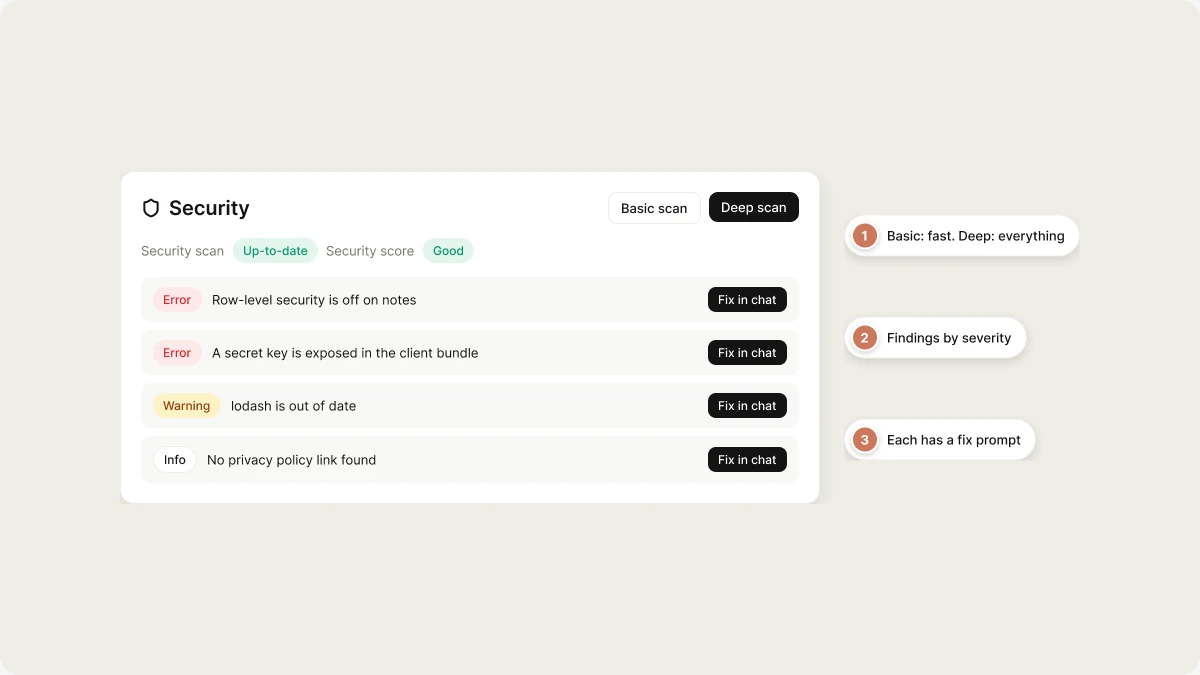 To open it, select **Manage** in the editor header, then select **Security**. The publish dialog also shows your latest scan result and links to the Security view when it finds critical issues.
The Security view covers one project. To monitor findings across every project in your workspace, use the [Security center](/features/workspace/security-center). For guidance on writing secure code in the first place, see [Security best practices](/features/security/best-practices).
## Why use the Security view
* **Catch issues before you publish.** Misconfigured database access, exposed secrets, and vulnerable packages are easier to fix before real users arrive.
* **Focus on what matters.** Findings are grouped by severity, so you can fix errors first and review the rest later.
* **Fix from the chat.** Each finding carries its own fix prompt, so you don't have to explain the problem to the agent yourself.
* **Know when results are stale.** The scan status tells you when your project has changed since the last scan.
## Understanding scan status
The status next to **Security scan** summarizes the whole project:
| Status | What it means |
| - | - |
| **Up-to-date** | Every scanner has run and its findings still reflect the current code. |
| **Outdated** | The project changed since a scanner last ran, so its findings may be stale. |
| **Scanning** | A scan is running now. |
| **Failed** | A scanner hit an error. Its area wasn't checked; the others still count. |
| **Never run** | No scan has completed on this project yet. |
Findings describe a snapshot of your code. When you edit the files a finding points at, it doesn't update on its own: the status changes to **Outdated** and you run a new scan.
The view also shows a **Security score** (**Excellent**, **Good**, **Fair**, or **At risk**) based on your open findings.
## Run Basic and Deep scans
Use the buttons at the top of the view. Both scans are free.
| Scan | What it checks | When it runs |
| - | - | - |
| **Basic scan** | A fast pass over your code: code security and sensitive data | Automatically in the background on every publish, or when you select it |
| **Deep scan** | Everything: code, dependencies, row-level security, database, and sensitive data | When you select it, or when you ask for a security scan in the chat |
The row-level security and database scanners need a linked [Supabase](/integrations/supabase) project. Without one, they're skipped with an info note and the other scanners still run.
Run a scan:
* before publishing
* after significant code or database changes
* after adding or updating packages
* periodically for apps in production
## Included security findings
| Scanner | What it looks for |
| - | - |
| **Row-level security** | Tables with RLS turned off, and policies so permissive they protect nothing |
| **Database security** | Supabase advisor findings, such as risky `SECURITY DEFINER` functions and exposed auth tables |
| **Code security review** | Hardcoded secrets, dynamic `eval`, dangerous HTML, and secrets leaking into client code. On mobile projects, also insecure `AsyncStorage` use, unvalidated deep links, and cleartext traffic |
| **Dependency audit** | Packages in `package.json` with known vulnerabilities |
| **Sensitive data (PII)** | Personal data written to logs, to storage, or to unencrypted fields |
Mobile projects get the mobile rules automatically.
## Review and fix findings
All findings appear under **Detected issues**, grouped by severity. Filter by severity at the top of the list.
| Severity | What to do |
| - | - |
| **Error** | Exploitable as written. Fix before you publish. |
| **Warning** | A real weakness that needs judgment, often a policy or a package where the right fix depends on your app. |
| **Info** | Worth knowing, such as a skipped scanner or a pattern that's fine here. |
Expand a finding to see which scanner produced it, the file and line, an explanation, and a **Suggested fix**. If the latest scan found nothing, the view says so, but a clean scan doesn't guarantee your app has no security risk.
You can address findings in several ways:
* **Fix one finding.** Select **Fix**. Vibely writes a prompt naming the finding, the file and line, and the suggested fix, and puts it in the chat. Review it, send it, and check the changes like any other edit.
* **Fix everything open.** Select **Try to fix all** to put one prompt covering every open finding in the chat.
* **Update vulnerable packages.** Select **Auto-fix deps** to upgrade vulnerable packages to their fixed versions. It only makes non-major upgrades, because a major version can change behavior. Majors are left for you to decide.
* **Ignore a finding.** If a finding doesn't apply, select **Ignore this finding** and give a reason. The reason is logged with your name, and you can **Unignore** it at any time.
Always review the changes and test your app after a fix.
## Review project dependencies
The **Project dependencies** card lists packages with known vulnerabilities from the latest deep scan. Select **Export JSON** to download the list for an audit or compliance review.
## Leaked password protection
When a Supabase project is linked, the view shows a **Leaked password protection** switch. Turn it on to block sign-ups and password changes that use passwords found in known data breaches (Have I Been Pwned).
## Improve scan accuracy with security memory
Select **Edit security memory** to add project-specific context. The scanners read it on every run. Use it to explain things that look wrong but are correct in your app, for example:
```text wrap theme={"system"}
The /admin route is behind Cloudflare Access; ignore unauthenticated-access warnings on it.
```
Use security memory to give context about your app, not to dismiss real issues.
## Publishing and security
Every publish starts a Basic scan in the background. It doesn't block that publish: the deploy proceeds and the findings land in the Security view.
Workspace owners and admins can go further with settings in **Settings → Privacy & security**. They apply to every project in the workspace:
| Setting | Effect when on |
| - | - |
| **Require basic security scan before first publish** | A project's first publish is blocked until a scan has completed. Republishing a live project isn't affected. |
| **Block publishing with critical issues** | Publishing is blocked while any open **Error** finding exists. |
| **Block publishing with PII** | Publishing is blocked while any open error or warning **Sensitive data** finding exists. Business plan. |
| **Who can publish externally** | Limits who can publish. Business plan. |
A blocked publish tells you which setting blocked it. The same rules apply to web publishing and mobile store submissions. See [Privacy & security](/features/workspace/privacy-security).
### Before a mobile build
A web deploy can be rolled back in a minute. A native binary in store review can't. Once submitted, you wait out the review, then submit a new build and wait again. So on mobile, scan first:
From the Security view, or ask for a security scan in the chat.
Judge warnings case by case. Fix errors.
See [Ship to stores](/features/mobile-apps/ship).
## Scheduled scans
On the **Business** plan, workspace admins can run deep scans on a schedule (weekly or monthly) for all projects or published projects only. Set this up in the [Security center](/features/workspace/security-center).
## Best practices
* **Keep findings current.** Rescan when the status says **Outdated**, especially after adding features, changing database access, or updating packages.
* **Fix errors first.** Error findings are usually exploitable.
* **Combine scans with a review.** Now and then, ask the agent to review your app's security in the chat. A narrative review can catch issues the scanners miss.
* **Be deliberate when ignoring.** Ignore a finding only when it clearly doesn't apply, and revisit ignored findings as your app changes.
* **Keep monitoring after publishing.** New features and new vulnerabilities in packages both create new findings.
Automated scans catch common issues, but they can't guarantee complete security. For apps that handle sensitive data or payments, consider a professional security review.
## FAQ
Select **Manage** in the editor header, then **Security**.
Your project changed since a scanner last ran, so its findings may no longer match your code. Run a Basic or Deep scan to refresh them.
A Deep scan runs Vibely's scanners and updates the findings in the Security view. Asking the agent to review your app's security in the chat gives you a written review and recommendations, and uses credits like any other chat turn. They're complementary.
Anyone with edit access to the project. Viewers can see the Security view but can't run scans or change findings.
Unless your workspace has **Block publishing with critical issues** turned on, the publish goes ahead. The publish dialog shows how many critical issues were found so you can review them first.
## Related
Avoid the most common findings in the first place.
Findings and dependency risk across your workspace.
Publishing gates and other workspace policies.
Where the publish-time scan runs.
## Related topics
- [View and edit your project's code](/features/projects/code-editor.md)
- [Find your way around the editor](/features/projects/editor.md)
- [Workspace Insights](/features/workspace/insights.md)
- [Vibely for Enterprise](/introduction/enterprise.md)
- [Workspace security center](/features/workspace/security-center.md)
This documentation is built and hosted on [Mintlify](https://mintlify.com), a developer documentation platform.
To open it, select **Manage** in the editor header, then select **Security**. The publish dialog also shows your latest scan result and links to the Security view when it finds critical issues.
The Security view covers one project. To monitor findings across every project in your workspace, use the [Security center](/features/workspace/security-center). For guidance on writing secure code in the first place, see [Security best practices](/features/security/best-practices).
## Why use the Security view
* **Catch issues before you publish.** Misconfigured database access, exposed secrets, and vulnerable packages are easier to fix before real users arrive.
* **Focus on what matters.** Findings are grouped by severity, so you can fix errors first and review the rest later.
* **Fix from the chat.** Each finding carries its own fix prompt, so you don't have to explain the problem to the agent yourself.
* **Know when results are stale.** The scan status tells you when your project has changed since the last scan.
## Understanding scan status
The status next to **Security scan** summarizes the whole project:
| Status | What it means |
| - | - |
| **Up-to-date** | Every scanner has run and its findings still reflect the current code. |
| **Outdated** | The project changed since a scanner last ran, so its findings may be stale. |
| **Scanning** | A scan is running now. |
| **Failed** | A scanner hit an error. Its area wasn't checked; the others still count. |
| **Never run** | No scan has completed on this project yet. |
Findings describe a snapshot of your code. When you edit the files a finding points at, it doesn't update on its own: the status changes to **Outdated** and you run a new scan.
The view also shows a **Security score** (**Excellent**, **Good**, **Fair**, or **At risk**) based on your open findings.
## Run Basic and Deep scans
Use the buttons at the top of the view. Both scans are free.
| Scan | What it checks | When it runs |
| - | - | - |
| **Basic scan** | A fast pass over your code: code security and sensitive data | Automatically in the background on every publish, or when you select it |
| **Deep scan** | Everything: code, dependencies, row-level security, database, and sensitive data | When you select it, or when you ask for a security scan in the chat |
The row-level security and database scanners need a linked [Supabase](/integrations/supabase) project. Without one, they're skipped with an info note and the other scanners still run.
Run a scan:
* before publishing
* after significant code or database changes
* after adding or updating packages
* periodically for apps in production
## Included security findings
| Scanner | What it looks for |
| - | - |
| **Row-level security** | Tables with RLS turned off, and policies so permissive they protect nothing |
| **Database security** | Supabase advisor findings, such as risky `SECURITY DEFINER` functions and exposed auth tables |
| **Code security review** | Hardcoded secrets, dynamic `eval`, dangerous HTML, and secrets leaking into client code. On mobile projects, also insecure `AsyncStorage` use, unvalidated deep links, and cleartext traffic |
| **Dependency audit** | Packages in `package.json` with known vulnerabilities |
| **Sensitive data (PII)** | Personal data written to logs, to storage, or to unencrypted fields |
Mobile projects get the mobile rules automatically.
## Review and fix findings
All findings appear under **Detected issues**, grouped by severity. Filter by severity at the top of the list.
| Severity | What to do |
| - | - |
| **Error** | Exploitable as written. Fix before you publish. |
| **Warning** | A real weakness that needs judgment, often a policy or a package where the right fix depends on your app. |
| **Info** | Worth knowing, such as a skipped scanner or a pattern that's fine here. |
Expand a finding to see which scanner produced it, the file and line, an explanation, and a **Suggested fix**. If the latest scan found nothing, the view says so, but a clean scan doesn't guarantee your app has no security risk.
You can address findings in several ways:
* **Fix one finding.** Select **Fix**. Vibely writes a prompt naming the finding, the file and line, and the suggested fix, and puts it in the chat. Review it, send it, and check the changes like any other edit.
* **Fix everything open.** Select **Try to fix all** to put one prompt covering every open finding in the chat.
* **Update vulnerable packages.** Select **Auto-fix deps** to upgrade vulnerable packages to their fixed versions. It only makes non-major upgrades, because a major version can change behavior. Majors are left for you to decide.
* **Ignore a finding.** If a finding doesn't apply, select **Ignore this finding** and give a reason. The reason is logged with your name, and you can **Unignore** it at any time.
Always review the changes and test your app after a fix.
## Review project dependencies
The **Project dependencies** card lists packages with known vulnerabilities from the latest deep scan. Select **Export JSON** to download the list for an audit or compliance review.
## Leaked password protection
When a Supabase project is linked, the view shows a **Leaked password protection** switch. Turn it on to block sign-ups and password changes that use passwords found in known data breaches (Have I Been Pwned).
## Improve scan accuracy with security memory
Select **Edit security memory** to add project-specific context. The scanners read it on every run. Use it to explain things that look wrong but are correct in your app, for example:
```text wrap theme={"system"}
The /admin route is behind Cloudflare Access; ignore unauthenticated-access warnings on it.
```
Use security memory to give context about your app, not to dismiss real issues.
## Publishing and security
Every publish starts a Basic scan in the background. It doesn't block that publish: the deploy proceeds and the findings land in the Security view.
Workspace owners and admins can go further with settings in **Settings → Privacy & security**. They apply to every project in the workspace:
| Setting | Effect when on |
| - | - |
| **Require basic security scan before first publish** | A project's first publish is blocked until a scan has completed. Republishing a live project isn't affected. |
| **Block publishing with critical issues** | Publishing is blocked while any open **Error** finding exists. |
| **Block publishing with PII** | Publishing is blocked while any open error or warning **Sensitive data** finding exists. Business plan. |
| **Who can publish externally** | Limits who can publish. Business plan. |
A blocked publish tells you which setting blocked it. The same rules apply to web publishing and mobile store submissions. See [Privacy & security](/features/workspace/privacy-security).
### Before a mobile build
A web deploy can be rolled back in a minute. A native binary in store review can't. Once submitted, you wait out the review, then submit a new build and wait again. So on mobile, scan first:
From the Security view, or ask for a security scan in the chat.
Judge warnings case by case. Fix errors.
See [Ship to stores](/features/mobile-apps/ship).
## Scheduled scans
On the **Business** plan, workspace admins can run deep scans on a schedule (weekly or monthly) for all projects or published projects only. Set this up in the [Security center](/features/workspace/security-center).
## Best practices
* **Keep findings current.** Rescan when the status says **Outdated**, especially after adding features, changing database access, or updating packages.
* **Fix errors first.** Error findings are usually exploitable.
* **Combine scans with a review.** Now and then, ask the agent to review your app's security in the chat. A narrative review can catch issues the scanners miss.
* **Be deliberate when ignoring.** Ignore a finding only when it clearly doesn't apply, and revisit ignored findings as your app changes.
* **Keep monitoring after publishing.** New features and new vulnerabilities in packages both create new findings.
Automated scans catch common issues, but they can't guarantee complete security. For apps that handle sensitive data or payments, consider a professional security review.
## FAQ
Select **Manage** in the editor header, then **Security**.
Your project changed since a scanner last ran, so its findings may no longer match your code. Run a Basic or Deep scan to refresh them.
A Deep scan runs Vibely's scanners and updates the findings in the Security view. Asking the agent to review your app's security in the chat gives you a written review and recommendations, and uses credits like any other chat turn. They're complementary.
Anyone with edit access to the project. Viewers can see the Security view but can't run scans or change findings.
Unless your workspace has **Block publishing with critical issues** turned on, the publish goes ahead. The publish dialog shows how many critical issues were found so you can review them first.
## Related
Avoid the most common findings in the first place.
Findings and dependency risk across your workspace.
Publishing gates and other workspace policies.
Where the publish-time scan runs.
## Related topics
- [View and edit your project's code](/features/projects/code-editor.md)
- [Find your way around the editor](/features/projects/editor.md)
- [Workspace Insights](/features/workspace/insights.md)
- [Vibely for Enterprise](/introduction/enterprise.md)
- [Workspace security center](/features/workspace/security-center.md)
This documentation is built and hosted on [Mintlify](https://mintlify.com), a developer documentation platform.