> ## Documentation Index
> Fetch the complete documentation index at: https://docs.vibely.sh/llms.txt
> Use this file to discover all available pages before exploring further.
# Project settings
> Where to find a project's settings and what each one does, from its name and access to public remixing, knowledge, domains, Git, and deleting the project.
**Project settings** is where you manage a single project: its name and URL, who can open it, public remixing, analytics, knowledge, custom domains, the Git connection, and deletion. This page walks through the settings section by section so you know exactly where each option lives.
Changes save as soon as you make them. There is no save button, and only deleting the project asks you to confirm.
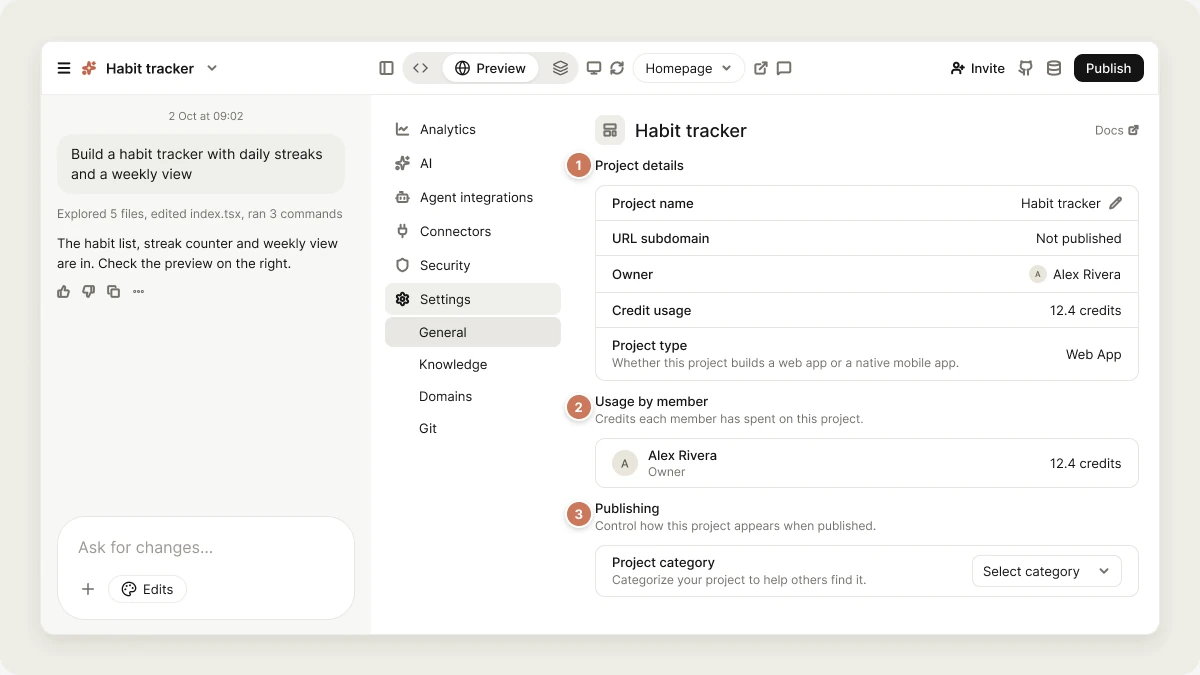 ## Where to find project settings
In the editor:
* **Manage panel**: Click **Manage** in the view switcher, then **Settings**. The panel has four tabs: **General**, **Knowledge**, **Domains** (web projects), and **Git**. See [The Manage panel](/features/projects/editor#the-manage-panel).
* **On a phone**: Tap **⋯** next to the chat input and choose **Project settings**.
Outside the editor:
* **Dashboard**: Open a project card's **⋯** menu and choose **Settings**. This opens the full settings page at `/code/project//settings`, with the project's sections under **Project** in the sidebar and your workspace and account settings below them.
Collaborators and invite links don't live here. Manage who can work in the project, and create preview links, from the **Invite** button in the top right of the editor. See [Collaboration](/features/collaboration/overview) and [Sharing](/features/collaboration/sharing).
## General
The **General** tab (called **Project settings** on the full settings page) opens by default and contains most settings.
### Overview
* **Project name**: The project's display name. Click the pencil to rename it. Renaming also updates the project's URL slug.
* **URL subdomain**: The address of your published web app, as a link. It reads **Not published** until you [publish](/features/deploy/publish) for the first time.
* **Owner**: Who owns the project.
* **Created at**: When the project was created.
### Usage by member
A table of the credits each person has spent in this project, with their workspace role. Messages from workspace members come out of the project's workspace credits; collaborators invited from outside the workspace are charged to their own workspace. This is where you see who spent what. It reads **No usage recorded for this project yet.** until the first message is billed. See [Credits](/features/account/credits).
### Access and sharing
* **Enable public remixing**: Let anyone with the project link view the latest version of your app and make their own copy of it. Off by default. Turning it on shows the link with a **Copy link** button. People who remix get a copy of your project's files, so make sure the code doesn't contain passwords, API keys, or personal data. See [Remix a project](/features/projects/remix).
* **Project category**: **Web App**, **Mobile App**, **API**, **Website**, **Tool**, or **Other**. This helps people find the project. It doesn't change how the project builds.
* **Project access**: **Workspace** lets every workspace member open the project in the editor. **Restricted** limits it to you and the people you invite, and requires a Business plan. New projects start with your workspace's default access, set in [Privacy & security](/features/workspace/privacy-security).
**Project access** controls who can open the project in the **editor**. Who can visit the **published site** is a separate setting in the publish flow. See [Sharing](/features/collaboration/sharing).
### Project
* **Rename project**: The same rename dialog as the pencil in **Overview**.
* **Disable analytics**: Stop collecting visitor analytics for this project. Off by default, so analytics are collected. See [Analytics](/features/grow/analytics).
* **Use as a template**: Publish this project as a template everyone in your workspace can start from. Turn it off to unpublish it. Business plan. See [Templates](/features/design/workspace-templates).
### Danger Zone
* **Delete project**: Permanently deletes the project, its files, its preview environment, and its deployment history. Click **Delete** and confirm.
Deleting a project is permanent. There is no trash and no restore, so [download your code](/features/projects/code-editor#download-your-projects-codebase) or [remix the project](/features/projects/remix) first if you might need it later.
## Knowledge
The **Knowledge** tab is where you write standing instructions for this project: what the product is, who it's for, and the rules Vibely should follow, like your brand colors or naming conventions. Vibely follows them in every message, so you don't have to repeat them in the chat. The same tab also shows your workspace-wide knowledge. See [Knowledge](/features/context/knowledge).
## Domains
The **Domains** tab is where you connect a domain you own to your published web app. Custom domains need a paid plan, and the tab appears on web projects only, because mobile apps publish to the app stores. See [Custom domains](/features/deploy/custom-domain).
## Git
The **Git** tab connects your project to a GitHub repository with two-way sync: changes Vibely makes are committed to your repository, and commits you push are pulled back into your project. A project uses one Git connection at a time. See [GitHub](/integrations/github).
The same tab has **Download codebase**, which saves your project's source code as a `.zip` file on any plan. See [Download your project's codebase](/features/projects/code-editor#download-your-projects-codebase).
## Mobile app
Mobile projects have a **Mobile app** section on the full settings page, with your app's store credentials, deep links, permissions, and release details for the App Store and Google Play. See [Ship to the stores](/features/mobile-apps/ship).
## Other settings you might be looking for
| Looking for | Where it is |
| - | - |
| Collaborators, roles, and invite links | The **Invite** button in the editor. See [Collaboration](/features/collaboration/overview). |
| Preview links | **Invite → Share preview**. See [Sharing](/features/collaboration/sharing). |
| Who can visit the published site | The publish flow. See [Publish your web app](/features/deploy/publish). |
| AI usage inside your app | **Manage → Vibely AI**. See [AI in your app](/features/backend/ai). |
| Connected services | **Manage → Connectors**. See [Connectors](/integrations/connectors/overview). |
| Secrets and API keys | **Secrets** in your account settings. See [Secrets](/features/backend/secrets). |
## FAQ
**Project access** in **General** controls who in your workspace can open the project in the editor. To invite specific people or create a preview link, use the **Invite** button in the editor. See [Collaboration](/features/collaboration/overview) and [Sharing](/features/collaboration/sharing).
Open **Manage → Settings → General** and click the pencil next to **Project name**, or **Rename** under **Rename project**. You can also rename from a project card's **⋯** menu on the dashboard, or from the project's **⋯** menu under **Recents** in the sidebar.
Not directly. To get a copy of the project into another workspace, switch to that workspace and [remix it](/features/projects/remix). The copy is independent of the original.
No. Deleting a project is permanent. If you might need it later, download the code or remix it before deleting.
## Related topics
What a project is and how to manage it.
Public remixing and what a copy includes.
Where every tool in a project lives.
Workspace defaults for new projects.
## Related topics
- [Workspace admin settings](/features/workspace/admin-settings.md)
- [Projects in Vibely](/features/projects/overview.md)
- [Collaborate on a project](/features/collaboration/overview.md)
- [Project analytics](/features/grow/analytics.md)
- [Remix a project](/features/projects/remix.md)
This documentation is built and hosted on [Mintlify](https://mintlify.com), a developer documentation platform.
## Where to find project settings
In the editor:
* **Manage panel**: Click **Manage** in the view switcher, then **Settings**. The panel has four tabs: **General**, **Knowledge**, **Domains** (web projects), and **Git**. See [The Manage panel](/features/projects/editor#the-manage-panel).
* **On a phone**: Tap **⋯** next to the chat input and choose **Project settings**.
Outside the editor:
* **Dashboard**: Open a project card's **⋯** menu and choose **Settings**. This opens the full settings page at `/code/project//settings`, with the project's sections under **Project** in the sidebar and your workspace and account settings below them.
Collaborators and invite links don't live here. Manage who can work in the project, and create preview links, from the **Invite** button in the top right of the editor. See [Collaboration](/features/collaboration/overview) and [Sharing](/features/collaboration/sharing).
## General
The **General** tab (called **Project settings** on the full settings page) opens by default and contains most settings.
### Overview
* **Project name**: The project's display name. Click the pencil to rename it. Renaming also updates the project's URL slug.
* **URL subdomain**: The address of your published web app, as a link. It reads **Not published** until you [publish](/features/deploy/publish) for the first time.
* **Owner**: Who owns the project.
* **Created at**: When the project was created.
### Usage by member
A table of the credits each person has spent in this project, with their workspace role. Messages from workspace members come out of the project's workspace credits; collaborators invited from outside the workspace are charged to their own workspace. This is where you see who spent what. It reads **No usage recorded for this project yet.** until the first message is billed. See [Credits](/features/account/credits).
### Access and sharing
* **Enable public remixing**: Let anyone with the project link view the latest version of your app and make their own copy of it. Off by default. Turning it on shows the link with a **Copy link** button. People who remix get a copy of your project's files, so make sure the code doesn't contain passwords, API keys, or personal data. See [Remix a project](/features/projects/remix).
* **Project category**: **Web App**, **Mobile App**, **API**, **Website**, **Tool**, or **Other**. This helps people find the project. It doesn't change how the project builds.
* **Project access**: **Workspace** lets every workspace member open the project in the editor. **Restricted** limits it to you and the people you invite, and requires a Business plan. New projects start with your workspace's default access, set in [Privacy & security](/features/workspace/privacy-security).
**Project access** controls who can open the project in the **editor**. Who can visit the **published site** is a separate setting in the publish flow. See [Sharing](/features/collaboration/sharing).
### Project
* **Rename project**: The same rename dialog as the pencil in **Overview**.
* **Disable analytics**: Stop collecting visitor analytics for this project. Off by default, so analytics are collected. See [Analytics](/features/grow/analytics).
* **Use as a template**: Publish this project as a template everyone in your workspace can start from. Turn it off to unpublish it. Business plan. See [Templates](/features/design/workspace-templates).
### Danger Zone
* **Delete project**: Permanently deletes the project, its files, its preview environment, and its deployment history. Click **Delete** and confirm.
Deleting a project is permanent. There is no trash and no restore, so [download your code](/features/projects/code-editor#download-your-projects-codebase) or [remix the project](/features/projects/remix) first if you might need it later.
## Knowledge
The **Knowledge** tab is where you write standing instructions for this project: what the product is, who it's for, and the rules Vibely should follow, like your brand colors or naming conventions. Vibely follows them in every message, so you don't have to repeat them in the chat. The same tab also shows your workspace-wide knowledge. See [Knowledge](/features/context/knowledge).
## Domains
The **Domains** tab is where you connect a domain you own to your published web app. Custom domains need a paid plan, and the tab appears on web projects only, because mobile apps publish to the app stores. See [Custom domains](/features/deploy/custom-domain).
## Git
The **Git** tab connects your project to a GitHub repository with two-way sync: changes Vibely makes are committed to your repository, and commits you push are pulled back into your project. A project uses one Git connection at a time. See [GitHub](/integrations/github).
The same tab has **Download codebase**, which saves your project's source code as a `.zip` file on any plan. See [Download your project's codebase](/features/projects/code-editor#download-your-projects-codebase).
## Mobile app
Mobile projects have a **Mobile app** section on the full settings page, with your app's store credentials, deep links, permissions, and release details for the App Store and Google Play. See [Ship to the stores](/features/mobile-apps/ship).
## Other settings you might be looking for
| Looking for | Where it is |
| - | - |
| Collaborators, roles, and invite links | The **Invite** button in the editor. See [Collaboration](/features/collaboration/overview). |
| Preview links | **Invite → Share preview**. See [Sharing](/features/collaboration/sharing). |
| Who can visit the published site | The publish flow. See [Publish your web app](/features/deploy/publish). |
| AI usage inside your app | **Manage → Vibely AI**. See [AI in your app](/features/backend/ai). |
| Connected services | **Manage → Connectors**. See [Connectors](/integrations/connectors/overview). |
| Secrets and API keys | **Secrets** in your account settings. See [Secrets](/features/backend/secrets). |
## FAQ
**Project access** in **General** controls who in your workspace can open the project in the editor. To invite specific people or create a preview link, use the **Invite** button in the editor. See [Collaboration](/features/collaboration/overview) and [Sharing](/features/collaboration/sharing).
Open **Manage → Settings → General** and click the pencil next to **Project name**, or **Rename** under **Rename project**. You can also rename from a project card's **⋯** menu on the dashboard, or from the project's **⋯** menu under **Recents** in the sidebar.
Not directly. To get a copy of the project into another workspace, switch to that workspace and [remix it](/features/projects/remix). The copy is independent of the original.
No. Deleting a project is permanent. If you might need it later, download the code or remix it before deleting.
## Related topics
What a project is and how to manage it.
Public remixing and what a copy includes.
Where every tool in a project lives.
Workspace defaults for new projects.
## Related topics
- [Workspace admin settings](/features/workspace/admin-settings.md)
- [Projects in Vibely](/features/projects/overview.md)
- [Collaborate on a project](/features/collaboration/overview.md)
- [Project analytics](/features/grow/analytics.md)
- [Remix a project](/features/projects/remix.md)
This documentation is built and hosted on [Mintlify](https://mintlify.com), a developer documentation platform.