> ## Documentation Index
> Fetch the complete documentation index at: https://docs.vibely.sh/llms.txt
> Use this file to discover all available pages before exploring further.
# Workspace templates
> Publish one of your projects as a workspace template so new projects start from its full codebase, design, and structure.
 ## What are workspace templates?
Workspace templates are available on the **Business** and **Enterprise** plans. They let your team reuse an approved project as the starting point for new ones, so styling, branding, and structure stay consistent.
A workspace template is one of your own projects, published for your workspace. When someone starts a project from it, the template's whole codebase is copied into the new project, including:
* File structure
* Components and styles
* Configuration files
* Project setup and scaffolding
Projects created from a template are fully independent. Changing one doesn't affect the template, and updating the template doesn't change projects already made from it.
Workspace templates are your team's own projects. They're different from the starter templates every Vibely project begins from, described in [Web app templates](/features/web-apps/templates) and [Mobile app templates](/features/mobile-apps/templates).
## Why use workspace templates?
* Keep design and architecture consistent across projects
* Start new projects from a proven codebase
* Skip repetitive setup work
* Share good patterns across the workspace
A template carries your actual code. If you want to share design rules without sharing code, see [Design systems](/features/design/design-systems).
## Prerequisites
* Your workspace must be on the **Business** or **Enterprise** plan. On other plans, the Templates page shows an upgrade prompt, and existing templates can't be listed.
* You must be a workspace **owner** or **admin**, and have permission to publish the project you're promoting.
* The project must belong to the same workspace.
## Publish a template
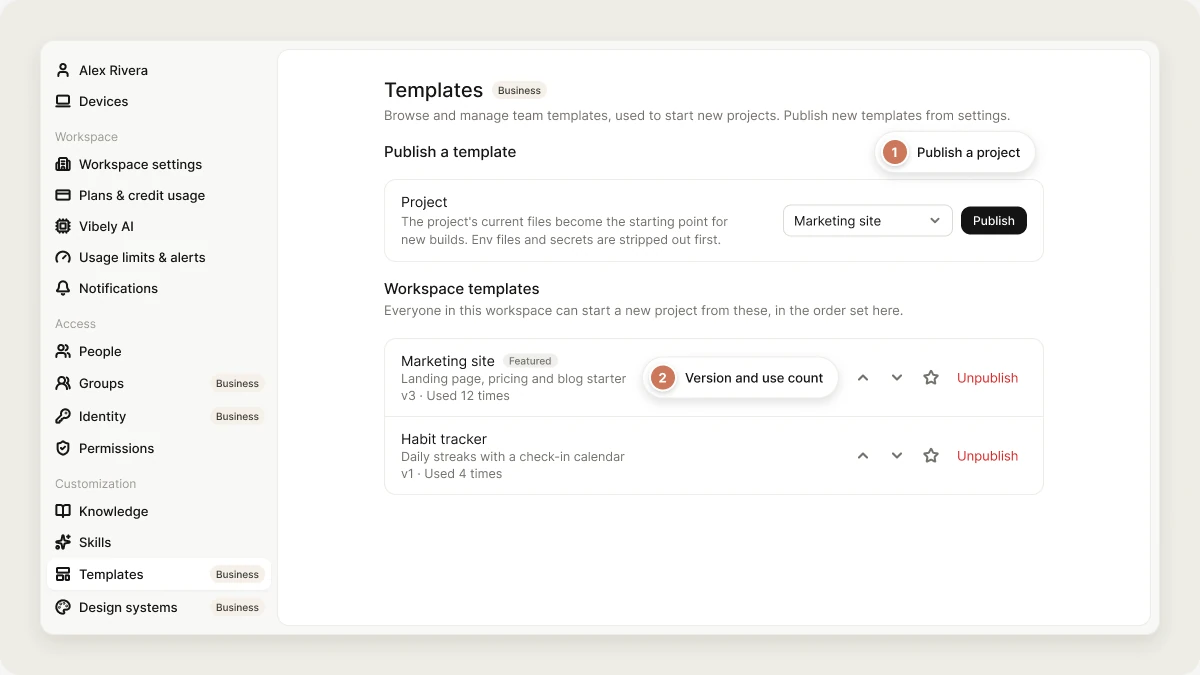
Go to **Settings → Templates**.
Under **Publish a template**, choose the **Project** to promote.
The project's current files become the starting point for new projects. Environment files and secrets are stripped out first.
The template appears under **Workspace templates**, with its version and how many times it has been used.
You can also publish from the project itself: open the project's **Settings** and turn on **Use as a template**. Turning it off unpublishes the template.
Stripping secrets works by recognizing secret-looking file names and values. It's a safety net, not a guarantee. Review the project before you publish it, especially for keys in unusual formats or credentials in comments or test data.
### Update a template
To update a template, publish the same project again. Vibely updates the existing template with the project's current files and increases its version number, rather than creating a second template. Projects already created from the template don't change.
## What are workspace templates?
Workspace templates are available on the **Business** and **Enterprise** plans. They let your team reuse an approved project as the starting point for new ones, so styling, branding, and structure stay consistent.
A workspace template is one of your own projects, published for your workspace. When someone starts a project from it, the template's whole codebase is copied into the new project, including:
* File structure
* Components and styles
* Configuration files
* Project setup and scaffolding
Projects created from a template are fully independent. Changing one doesn't affect the template, and updating the template doesn't change projects already made from it.
Workspace templates are your team's own projects. They're different from the starter templates every Vibely project begins from, described in [Web app templates](/features/web-apps/templates) and [Mobile app templates](/features/mobile-apps/templates).
## Why use workspace templates?
* Keep design and architecture consistent across projects
* Start new projects from a proven codebase
* Skip repetitive setup work
* Share good patterns across the workspace
A template carries your actual code. If you want to share design rules without sharing code, see [Design systems](/features/design/design-systems).
## Prerequisites
* Your workspace must be on the **Business** or **Enterprise** plan. On other plans, the Templates page shows an upgrade prompt, and existing templates can't be listed.
* You must be a workspace **owner** or **admin**, and have permission to publish the project you're promoting.
* The project must belong to the same workspace.
## Publish a template
Go to **Settings → Templates**.
Under **Publish a template**, choose the **Project** to promote.
The project's current files become the starting point for new projects. Environment files and secrets are stripped out first.
The template appears under **Workspace templates**, with its version and how many times it has been used.
You can also publish from the project itself: open the project's **Settings** and turn on **Use as a template**. Turning it off unpublishes the template.
Stripping secrets works by recognizing secret-looking file names and values. It's a safety net, not a guarantee. Review the project before you publish it, especially for keys in unusual formats or credentials in comments or test data.
### Update a template
To update a template, publish the same project again. Vibely updates the existing template with the project's current files and increases its version number, rather than creating a second template. Projects already created from the template don't change.
 ## Manage workspace templates
In **Settings → Templates**, under **Workspace templates**:
* **Feature**: pin a template to the top of the list, marked with a star in the template picker. Click **Unfeature** to undo it.
* **Move up** and **Move down**: set the order members see.
* **Unpublish**: remove the template. The source project isn't affected, and you can publish it again later.
## Start a project from a workspace template
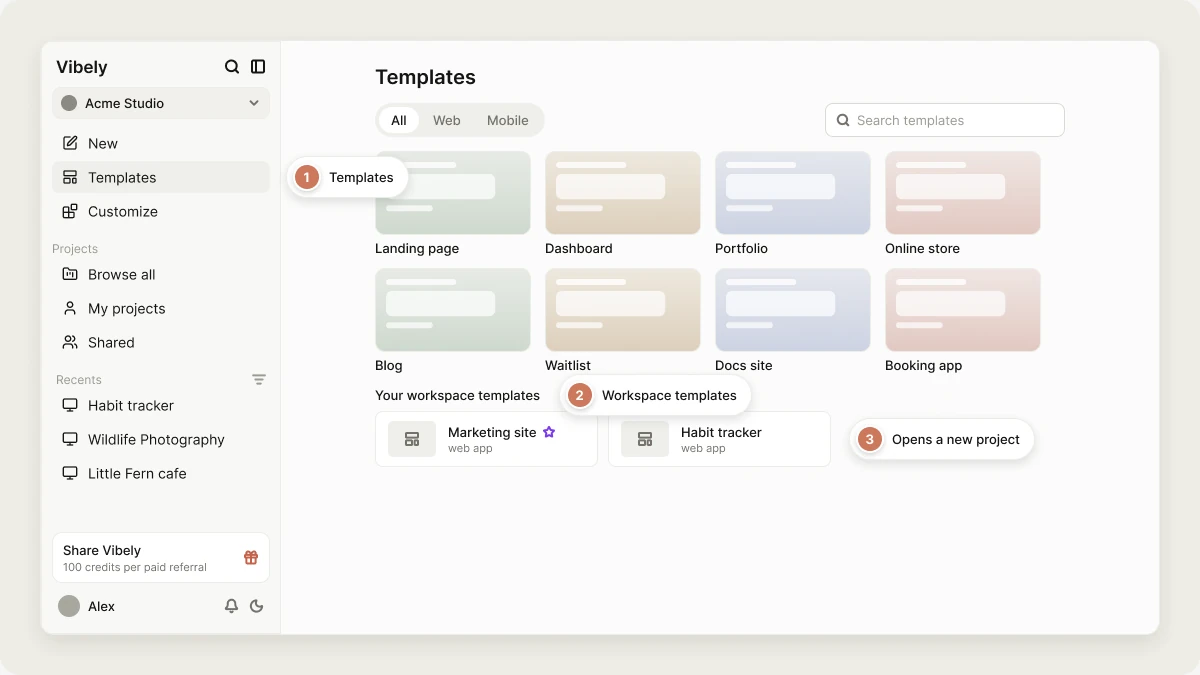
Workspace templates appear on the **Templates** page in the sidebar, under **Your workspace templates**, after Vibely's own templates.
Pick one and Vibely creates the project in your current workspace and opens it. You can also do this from an AI tool through the [Vibely MCP server](/integrations/vibely-mcp-server): list your templates with `list_template_projects`, then pass one to `create_project`.
A new project created from a workspace template gets:
* Every file from the template
* The template's project type, web or mobile
Environment variables, secrets, connector connections, and custom domains aren't copied. They belong to the project where they were set up, so configure them again in the new project.
Your prompt still decides what gets built on top of the template.
## Mobile templates and store identifiers
A mobile template's `app.json` is copied as is, including its iOS bundle identifier and Android package name. Two apps made from the same template would otherwise share the same store identity.
* **If you use a mobile template**, set a new bundle identifier in the new project's mobile app settings **before its first build**. Identifiers can't change after the first build, because the App Store and Google Play don't allow it.
* **If you publish a mobile template**, remove `ios.bundleIdentifier` and `android.package` from the source project's `app.json` first. New projects then stop at the first build with a clear message asking for an identifier, instead of silently reusing yours.
See [Ship your mobile app](/features/mobile-apps/ship).
## FAQ
Everyone in the workspace, in the order set on the Templates page. Workspace templates are never listed publicly.
No. It only removes the template. The source project stays as it is.
Workspace templates need the Business plan. After a downgrade, the Templates page shows an upgrade prompt and templates can't be listed or used until you upgrade again.
## Related topics
Share design rules instead of code.
How Vibely shapes the look of a new project.
Manage your workspace.
Compare Business and Enterprise.
## Related topics
- [Web app templates](/features/web-apps/templates.md)
- [Mobile app templates](/features/mobile-apps/templates.md)
- [Design systems](/features/design/design-systems.md)
- [Dashboard overview](/introduction/dashboard.md)
- [Vibely for Enterprise](/introduction/enterprise.md)
This documentation is built and hosted on [Mintlify](https://mintlify.com), a developer documentation platform.
## Manage workspace templates
In **Settings → Templates**, under **Workspace templates**:
* **Feature**: pin a template to the top of the list, marked with a star in the template picker. Click **Unfeature** to undo it.
* **Move up** and **Move down**: set the order members see.
* **Unpublish**: remove the template. The source project isn't affected, and you can publish it again later.
## Start a project from a workspace template
Workspace templates appear on the **Templates** page in the sidebar, under **Your workspace templates**, after Vibely's own templates.
Pick one and Vibely creates the project in your current workspace and opens it. You can also do this from an AI tool through the [Vibely MCP server](/integrations/vibely-mcp-server): list your templates with `list_template_projects`, then pass one to `create_project`.
A new project created from a workspace template gets:
* Every file from the template
* The template's project type, web or mobile
Environment variables, secrets, connector connections, and custom domains aren't copied. They belong to the project where they were set up, so configure them again in the new project.
Your prompt still decides what gets built on top of the template.
## Mobile templates and store identifiers
A mobile template's `app.json` is copied as is, including its iOS bundle identifier and Android package name. Two apps made from the same template would otherwise share the same store identity.
* **If you use a mobile template**, set a new bundle identifier in the new project's mobile app settings **before its first build**. Identifiers can't change after the first build, because the App Store and Google Play don't allow it.
* **If you publish a mobile template**, remove `ios.bundleIdentifier` and `android.package` from the source project's `app.json` first. New projects then stop at the first build with a clear message asking for an identifier, instead of silently reusing yours.
See [Ship your mobile app](/features/mobile-apps/ship).
## FAQ
Everyone in the workspace, in the order set on the Templates page. Workspace templates are never listed publicly.
No. It only removes the template. The source project stays as it is.
Workspace templates need the Business plan. After a downgrade, the Templates page shows an upgrade prompt and templates can't be listed or used until you upgrade again.
## Related topics
Share design rules instead of code.
How Vibely shapes the look of a new project.
Manage your workspace.
Compare Business and Enterprise.
## Related topics
- [Web app templates](/features/web-apps/templates.md)
- [Mobile app templates](/features/mobile-apps/templates.md)
- [Design systems](/features/design/design-systems.md)
- [Dashboard overview](/introduction/dashboard.md)
- [Vibely for Enterprise](/introduction/enterprise.md)
This documentation is built and hosted on [Mintlify](https://mintlify.com), a developer documentation platform.