> ## Documentation Index
> Fetch the complete documentation index at: https://docs.vibely.sh/llms.txt
> Use this file to discover all available pages before exploring further.
# Deployment, hosting and ownership options
> You own your code and your data. See what Vibely runs for you, what you would run yourself, and how to move parts of your stack.
Vibely is built to be the fastest way to go from an idea to a live app: an AI agent, a live preview, and managed hosting, so you can focus on building rather than operating servers. For what hosting means in practice, see [How Vibely hosts your app](/features/deploy/hosting).
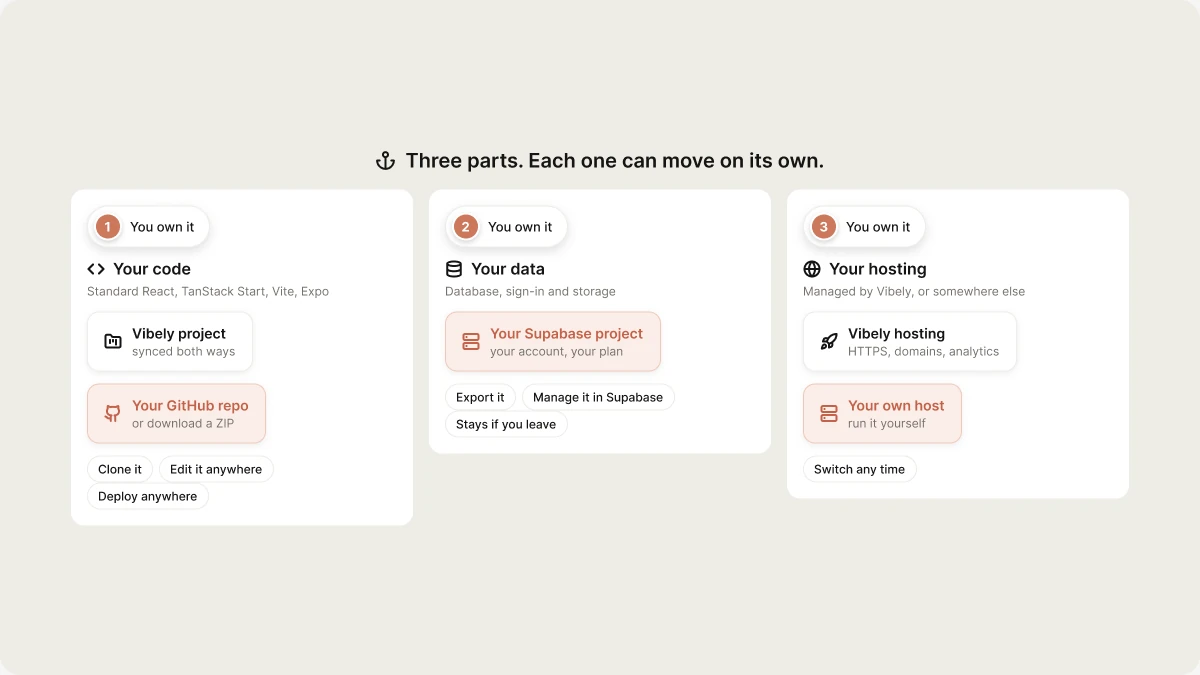 Vibely is also built so that **you are never locked in**. You can sync or download your code, keep your data in your own account, and host part or all of your app somewhere else at any time.
## Key principles
* **You own your code.** Sync any project to a GitHub repository with two-way [Git sync](/integrations/git-sync), or download it as a ZIP. You can clone it, change it outside Vibely, and deploy it anywhere.
* **You own your data.** Your app's database, sign-in and storage live in **your own** [Supabase](/integrations/supabase) project, in your Supabase account, not in a Vibely-owned store. You can manage, export or move it with Supabase's own tools.
* **Standard, open-source technology.** Web apps are standard TypeScript projects built with React, TanStack Start, Vite and Tailwind. Mobile apps are standard Expo (React Native) projects. There's no proprietary runtime to replace.
## What you get with Vibely hosting
When you publish with Vibely, development, preview and production work together:
* An AI agent and live preview wired directly into your app
* One-click publishing with automatic HTTPS and global delivery
* Custom domains and branded workspace URLs
* Website access control (Business)
* Security scans before you publish
* Built-in [analytics](/features/grow/analytics) and [error monitoring](/features/grow/monitoring)
* Mobile builds and store submission from the same project
## What changes if you stop using Vibely
If you move off Vibely entirely, you take over the parts Vibely was running for you:
* Your development environment and build process
* Deployments, CI/CD and release process
* Hosting, HTTPS certificates, domains and scaling
* Error monitoring and analytics
* Mobile builds and store submissions (with your own Expo/EAS account)
Your Supabase project, your data, and any connected services such as Stripe or RevenueCat stay exactly where they are, because they're already in your accounts.
## How Vibely fits into your stack
A Vibely app has three parts, and each one can move independently:
| Part | Default | Can also run on |
| - | - | - |
| **Code** | Managed in Vibely, optionally synced to GitHub | Any Git workflow |
| **Frontend (web)** | Vibely hosting, with custom domains | Your own Cloudflare account, or another platform after changing the server target |
| **Backend and data** | Your own Supabase project | Another Supabase project, or self-hosted Supabase |
## Common setups
### Everything on Vibely (recommended)
* Build, preview and host on Vibely.
* Backend in your own Supabase project.
* Custom domain connected in Vibely.
Best for most apps. Nothing to operate.
### Vibely + your own hosting (hybrid)
* Build in Vibely, with the code synced to GitHub.
* Deploy the frontend from GitHub to your own hosting.
* Backend stays in your Supabase project.
Best when your organization requires a specific hosting provider or deployment pipeline. See [Deploy outside Vibely](/features/deploy/external-hosting).
### Fully self-managed (advanced)
* Code lives in your repository, and you develop outside Vibely (or keep using Vibely for some of it).
* Frontend deployed through your own pipeline.
* Backend on self-hosted Supabase or a separate Supabase project you operate.
The Vibely editor and agent are a managed service. They can't be self-hosted or run inside your own network. The apps you build with them can be hosted anywhere.
## Recommended path
1. **Start on Vibely.** It's the fastest way to production, with nothing to operate.
2. **Sync your code to GitHub.** You always have a copy of your code, and others can work on it with their own tools.
3. **Move a part only when you hit a real constraint**, such as a compliance requirement tied to a specific provider, private networking, or an organization policy that requires self-managed hosting.
## Related
Step-by-step external hosting.
What happens after you publish.
Two-way sync with GitHub.
Vibely for larger organizations.
## Related topics
- [Deploy and host outside Vibely](/features/deploy/external-hosting.md)
- [View and edit your project's code](/features/projects/code-editor.md)
- [How Vibely hosts your app](/features/deploy/hosting.md)
- [Connect a custom domain](/features/deploy/custom-domain.md)
- [Glossary](/glossary.md)
This documentation is built and hosted on [Mintlify](https://mintlify.com), a developer documentation platform.
Vibely is also built so that **you are never locked in**. You can sync or download your code, keep your data in your own account, and host part or all of your app somewhere else at any time.
## Key principles
* **You own your code.** Sync any project to a GitHub repository with two-way [Git sync](/integrations/git-sync), or download it as a ZIP. You can clone it, change it outside Vibely, and deploy it anywhere.
* **You own your data.** Your app's database, sign-in and storage live in **your own** [Supabase](/integrations/supabase) project, in your Supabase account, not in a Vibely-owned store. You can manage, export or move it with Supabase's own tools.
* **Standard, open-source technology.** Web apps are standard TypeScript projects built with React, TanStack Start, Vite and Tailwind. Mobile apps are standard Expo (React Native) projects. There's no proprietary runtime to replace.
## What you get with Vibely hosting
When you publish with Vibely, development, preview and production work together:
* An AI agent and live preview wired directly into your app
* One-click publishing with automatic HTTPS and global delivery
* Custom domains and branded workspace URLs
* Website access control (Business)
* Security scans before you publish
* Built-in [analytics](/features/grow/analytics) and [error monitoring](/features/grow/monitoring)
* Mobile builds and store submission from the same project
## What changes if you stop using Vibely
If you move off Vibely entirely, you take over the parts Vibely was running for you:
* Your development environment and build process
* Deployments, CI/CD and release process
* Hosting, HTTPS certificates, domains and scaling
* Error monitoring and analytics
* Mobile builds and store submissions (with your own Expo/EAS account)
Your Supabase project, your data, and any connected services such as Stripe or RevenueCat stay exactly where they are, because they're already in your accounts.
## How Vibely fits into your stack
A Vibely app has three parts, and each one can move independently:
| Part | Default | Can also run on |
| - | - | - |
| **Code** | Managed in Vibely, optionally synced to GitHub | Any Git workflow |
| **Frontend (web)** | Vibely hosting, with custom domains | Your own Cloudflare account, or another platform after changing the server target |
| **Backend and data** | Your own Supabase project | Another Supabase project, or self-hosted Supabase |
## Common setups
### Everything on Vibely (recommended)
* Build, preview and host on Vibely.
* Backend in your own Supabase project.
* Custom domain connected in Vibely.
Best for most apps. Nothing to operate.
### Vibely + your own hosting (hybrid)
* Build in Vibely, with the code synced to GitHub.
* Deploy the frontend from GitHub to your own hosting.
* Backend stays in your Supabase project.
Best when your organization requires a specific hosting provider or deployment pipeline. See [Deploy outside Vibely](/features/deploy/external-hosting).
### Fully self-managed (advanced)
* Code lives in your repository, and you develop outside Vibely (or keep using Vibely for some of it).
* Frontend deployed through your own pipeline.
* Backend on self-hosted Supabase or a separate Supabase project you operate.
The Vibely editor and agent are a managed service. They can't be self-hosted or run inside your own network. The apps you build with them can be hosted anywhere.
## Recommended path
1. **Start on Vibely.** It's the fastest way to production, with nothing to operate.
2. **Sync your code to GitHub.** You always have a copy of your code, and others can work on it with their own tools.
3. **Move a part only when you hit a real constraint**, such as a compliance requirement tied to a specific provider, private networking, or an organization policy that requires self-managed hosting.
## Related
Step-by-step external hosting.
What happens after you publish.
Two-way sync with GitHub.
Vibely for larger organizations.
## Related topics
- [Deploy and host outside Vibely](/features/deploy/external-hosting.md)
- [View and edit your project's code](/features/projects/code-editor.md)
- [How Vibely hosts your app](/features/deploy/hosting.md)
- [Connect a custom domain](/features/deploy/custom-domain.md)
- [Glossary](/glossary.md)
This documentation is built and hosted on [Mintlify](https://mintlify.com), a developer documentation platform.