> ## Documentation Index
> Fetch the complete documentation index at: https://docs.vibely.sh/llms.txt
> Use this file to discover all available pages before exploring further.
# Managed registry
> Publish private npm packages to a registry hosted inside your Vibely workspace and install them in your workspace's projects.
The managed registry gives your workspace its own private npm registry, hosted inside Vibely. You can publish packages to it without making them public, and any project in your workspace can install them.
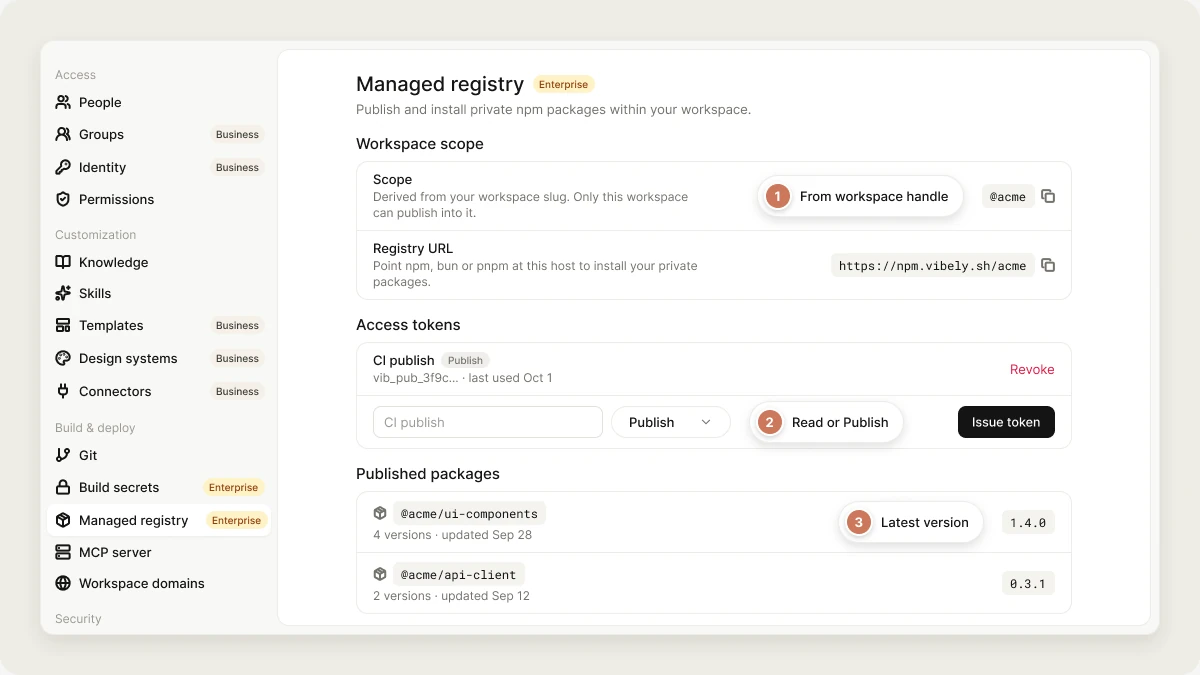 Workspace owners and admins manage access tokens. Other members can see the registry's scope, URL, and published packages.
Open the managed registry from **Settings → Build & deploy → Managed registry**.
## Why use a managed registry
Teams often keep shared code, such as a design system, utility functions, or an internal API client, in private npm packages that shouldn't be public. With a managed registry you can:
* Install internal packages in Vibely projects without running your own registry.
* Keep proprietary code private.
* Reuse versioned internal libraries consistently across projects.
## Common use cases
* **Internal component libraries**: install your organization's UI components in Vibely projects.
* **Shared utilities**: reuse validation, formatting, or data-fetching code across projects.
* **Internal SDKs**: install API clients that can't be published publicly.
## Prerequisites
* The **Enterprise** plan.
* The **owner** or **admin** role to issue tokens.
## Your scope
Your registry publishes into one npm scope, taken from your workspace's slug. A workspace with the slug `acme` publishes packages named `@acme/...`. The scope can't be chosen, which is what stops one workspace from publishing into another's namespace.
If your workspace has no valid slug, the page says the registry has no scope yet. Rename the workspace in **Settings → Workspace settings** to create one.
Renaming your workspace changes your npm scope. Packages already published under the old scope stay there, and new ones go to the new scope. Rename before you publish, not after.
## Set up the managed registry
Go to **Settings → Managed registry**. The page shows your **Scope** and **Registry URL**, with buttons to copy each.
Under **Access tokens**, choose a **Capability**, give the token a name, and select **Issue token**. Copy the token right away. It's shown once and can't be retrieved again.
| Capability | What it can do |
| - | - |
| **Read** | Install packages from your scope. |
| **Publish** | Everything Read can do, plus publish new versions. |
A publish token can ship code into every project in your workspace. Give publish tokens to CI only, and use read tokens everywhere else.
In your package's own repository, add the `.npmrc` snippet from the settings page, set `NPM_TOKEN` to a publish token in your CI environment, and run `npm publish`. The package name must start with your scope.
## View published packages
Published packages appear under **Published packages** on the same settings page, with how many versions each has and when it was last updated.
## Use a private package in a project
To install from the registry, your projects need a read token.
In **Settings → Build secrets**, add a [build secret](/features/build/build-secrets) named `NPM_TOKEN` whose value is a read token.
In the **Package registries** card on the same page, select **Add registry**. Enter your scope, paste the **Registry URL**, and choose `NPM_TOKEN` as the token. Vibely keeps the matching `.npmrc` block in every project in the workspace.
Prompt the agent with the package name, just like a public package:
```text wrap theme={"system"}
Install @acme/ui-components and use it to replace the current button component.
```
The `.npmrc` block references the token by name, so it's never written into your project's files:
```ini theme={"system"}
@acme:registry=https:///npm/
///npm/:_authToken=${NPM_TOKEN}
```
## Rotate or revoke a token
Tokens can't be edited in place. To rotate one:
Same capability, with a name that says what it's for.
Replace the value of the build secret, or your CI variable, that holds the old token.
Select **Revoke** next to it. Installs and publishes using it start failing immediately, which shows you anything you missed.
Each token shows its prefix and when it was last used, so you can tell which ones are still active.
## Limits
| Limit | Value |
| - | - |
| Active tokens | 20 per workspace |
| Package name length | 214 characters, including the scope |
| Package size | 18 MB per published version |
| Registry requests | 600 per minute per token |
## FAQ
Yes, once the scope is added under **Package registries** with a read token. Every project in the workspace gets the same `.npmrc` block.
No. A version can be published once. Publish a new version instead.
You don't need the managed registry. Add that registry's token as a [build secret](/features/build/build-secrets) and add the registry under **Package registries**.
## Related
Where your registry token lives.
How Vibely installs packages.
Everything else admins control.
What the Enterprise plan includes.
## Related topics
- [Workspace admin settings](/features/workspace/admin-settings.md)
- [Build secrets](/features/build/build-secrets.md)
- [Use npm packages](/features/build/npm-packages.md)
- [Vibely for Enterprise](/introduction/enterprise.md)
- [Glossary](/glossary.md)
This documentation is built and hosted on [Mintlify](https://mintlify.com), a developer documentation platform.
Workspace owners and admins manage access tokens. Other members can see the registry's scope, URL, and published packages.
Open the managed registry from **Settings → Build & deploy → Managed registry**.
## Why use a managed registry
Teams often keep shared code, such as a design system, utility functions, or an internal API client, in private npm packages that shouldn't be public. With a managed registry you can:
* Install internal packages in Vibely projects without running your own registry.
* Keep proprietary code private.
* Reuse versioned internal libraries consistently across projects.
## Common use cases
* **Internal component libraries**: install your organization's UI components in Vibely projects.
* **Shared utilities**: reuse validation, formatting, or data-fetching code across projects.
* **Internal SDKs**: install API clients that can't be published publicly.
## Prerequisites
* The **Enterprise** plan.
* The **owner** or **admin** role to issue tokens.
## Your scope
Your registry publishes into one npm scope, taken from your workspace's slug. A workspace with the slug `acme` publishes packages named `@acme/...`. The scope can't be chosen, which is what stops one workspace from publishing into another's namespace.
If your workspace has no valid slug, the page says the registry has no scope yet. Rename the workspace in **Settings → Workspace settings** to create one.
Renaming your workspace changes your npm scope. Packages already published under the old scope stay there, and new ones go to the new scope. Rename before you publish, not after.
## Set up the managed registry
Go to **Settings → Managed registry**. The page shows your **Scope** and **Registry URL**, with buttons to copy each.
Under **Access tokens**, choose a **Capability**, give the token a name, and select **Issue token**. Copy the token right away. It's shown once and can't be retrieved again.
| Capability | What it can do |
| - | - |
| **Read** | Install packages from your scope. |
| **Publish** | Everything Read can do, plus publish new versions. |
A publish token can ship code into every project in your workspace. Give publish tokens to CI only, and use read tokens everywhere else.
In your package's own repository, add the `.npmrc` snippet from the settings page, set `NPM_TOKEN` to a publish token in your CI environment, and run `npm publish`. The package name must start with your scope.
## View published packages
Published packages appear under **Published packages** on the same settings page, with how many versions each has and when it was last updated.
## Use a private package in a project
To install from the registry, your projects need a read token.
In **Settings → Build secrets**, add a [build secret](/features/build/build-secrets) named `NPM_TOKEN` whose value is a read token.
In the **Package registries** card on the same page, select **Add registry**. Enter your scope, paste the **Registry URL**, and choose `NPM_TOKEN` as the token. Vibely keeps the matching `.npmrc` block in every project in the workspace.
Prompt the agent with the package name, just like a public package:
```text wrap theme={"system"}
Install @acme/ui-components and use it to replace the current button component.
```
The `.npmrc` block references the token by name, so it's never written into your project's files:
```ini theme={"system"}
@acme:registry=https:///npm/
///npm/:_authToken=${NPM_TOKEN}
```
## Rotate or revoke a token
Tokens can't be edited in place. To rotate one:
Same capability, with a name that says what it's for.
Replace the value of the build secret, or your CI variable, that holds the old token.
Select **Revoke** next to it. Installs and publishes using it start failing immediately, which shows you anything you missed.
Each token shows its prefix and when it was last used, so you can tell which ones are still active.
## Limits
| Limit | Value |
| - | - |
| Active tokens | 20 per workspace |
| Package name length | 214 characters, including the scope |
| Package size | 18 MB per published version |
| Registry requests | 600 per minute per token |
## FAQ
Yes, once the scope is added under **Package registries** with a read token. Every project in the workspace gets the same `.npmrc` block.
No. A version can be published once. Publish a new version instead.
You don't need the managed registry. Add that registry's token as a [build secret](/features/build/build-secrets) and add the registry under **Package registries**.
## Related
Where your registry token lives.
How Vibely installs packages.
Everything else admins control.
What the Enterprise plan includes.
## Related topics
- [Workspace admin settings](/features/workspace/admin-settings.md)
- [Build secrets](/features/build/build-secrets.md)
- [Use npm packages](/features/build/npm-packages.md)
- [Vibely for Enterprise](/introduction/enterprise.md)
- [Glossary](/glossary.md)
This documentation is built and hosted on [Mintlify](https://mintlify.com), a developer documentation platform.